
Ch 10: Interactions and Potential Energy
Knight Calc - Physics for Scientists and Engineers 5th Edition
Knight Calc5th EditionPhysics for Scientists and EngineersISBN: 9780137344796당신이 사용하는 게 아니라요?교과서 변경
10장, 문제 48

A horizontal spring with spring constant 100 N/m is compressed 20 cm and used to launch a 2.5 kg box across a frictionless, horizontal surface. After the box travels some distance, the surface becomes rough. The coefficient of kinetic friction of the box on the surface is 0.15. Use work and energy to find how far the box slides across the rough surface before stopping.

검증된 단계별 안내
1
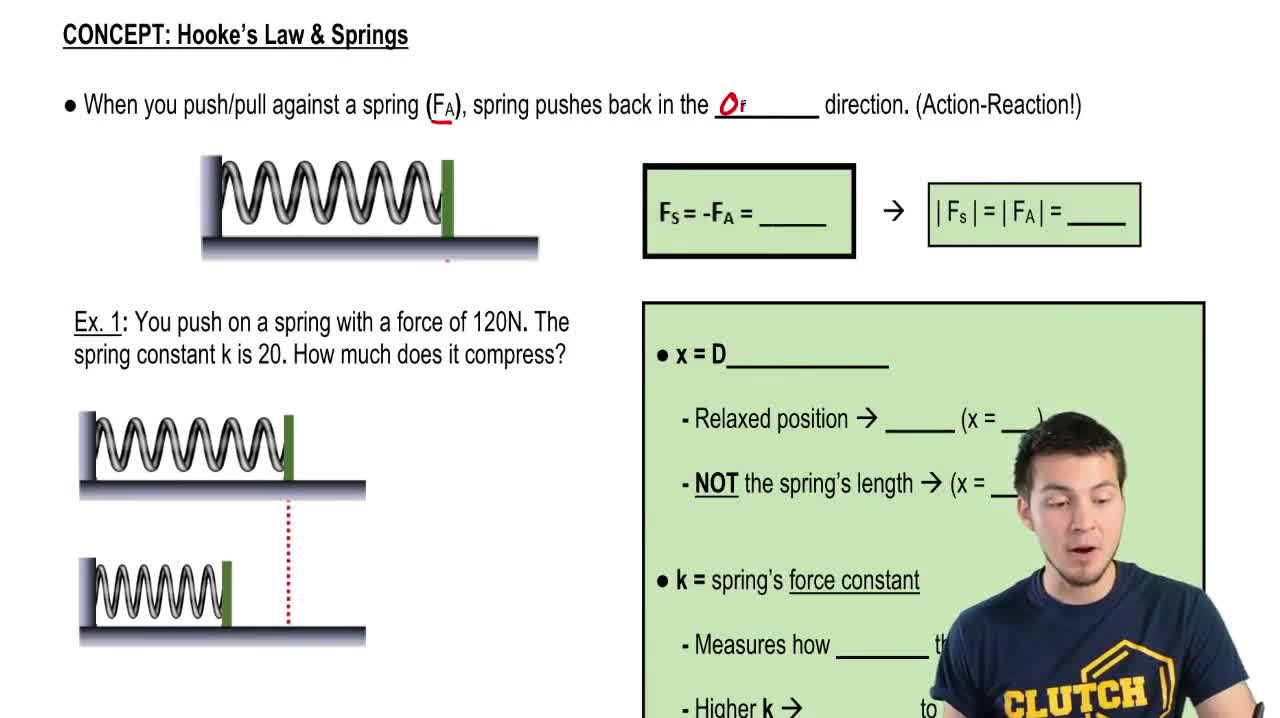
Step 1: Calculate the initial elastic potential energy stored in the spring using the formula \( U_s = \frac{1}{2} k x^2 \), where \( k \) is the spring constant (100 N/m) and \( x \) is the compression of the spring (0.20 m).
Step 2: Recognize that the initial elastic potential energy of the spring is converted into the kinetic energy of the box as it leaves the spring, and then into work done against friction as the box slides on the rough surface. The work-energy principle states \( U_s = W_f \), where \( W_f \) is the work done by friction.
Step 3: Express the work done by friction as \( W_f = f_k d \), where \( f_k \) is the kinetic friction force and \( d \) is the distance the box slides. The kinetic friction force is given by \( f_k = \mu_k m g \), where \( \mu_k \) is the coefficient of kinetic friction (0.15), \( m \) is the mass of the box (2.5 kg), and \( g \) is the acceleration due to gravity (9.8 m/s^2).
Step 4: Substitute \( f_k \) into the work equation \( W_f = f_k d \), and set it equal to the initial elastic potential energy \( U_s \). Solve for \( d \), the distance the box slides: \( d = \frac{U_s}{f_k} \).
Step 5: Plug in the values for \( U_s \) (from Step 1) and \( f_k \) (from Step 3) into the equation for \( d \) to find the distance the box slides before stopping. Ensure all units are consistent during calculations.

비슷한 문제에 대한 검증된 영상 답변:

이 영상 해법은 위 문제에 도움이 된다고 튜터들이 추천한 것입니다.
영상 길이:
7m
도움이 되었나요?

주요 개념

질문에 올바르게 답하기 위해 반드시 이해해야 하는 핵심 개념들은 다음과 같습니다.

Hooke's Law

Hooke's Law states that the force exerted by a spring is directly proportional to its displacement from the equilibrium position, expressed as F = -kx, where k is the spring constant and x is the displacement. In this scenario, the spring constant is 100 N/m, and the spring is compressed by 0.2 m, allowing us to calculate the potential energy stored in the spring, which is converted into kinetic energy when the box is launched.
추천 영상:
가이드 코스
05:27
Spring Force (Hooke's Law)

Work-Energy Principle

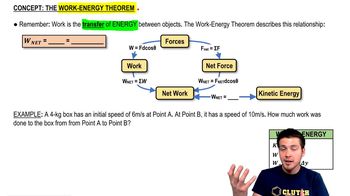
The Work-Energy Principle states that the work done on an object is equal to the change in its kinetic energy. In this case, the initial kinetic energy of the box, derived from the spring's potential energy, will be reduced by the work done against friction as the box slides across the rough surface. This principle allows us to relate the initial energy to the distance traveled before the box comes to a stop.
추천 영상:
가이드 코스
04:10
The Work-Energy Theorem

Friction and Kinetic Energy Loss

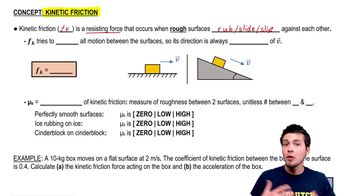
Friction is a force that opposes the motion of an object, and the coefficient of kinetic friction quantifies this resistance. The work done by friction can be calculated using the formula W_friction = f_friction * d, where f_friction is the frictional force and d is the distance traveled. In this problem, the kinetic energy lost due to friction will determine how far the box slides before stopping, allowing us to find the distance using the relationship between work and energy.
추천 영상:
가이드 코스
06:18
Kinetic Friction Problems
관련 실천
교과서 질문

You have been hired to design a spring-launched roller coaster that will carry two passengers per car. The car goes up a 10-m-high hill, then descends 15 m to the track's lowest point. You've determined that the spring can be compressed a maximum of 2.0 m and that a loaded car will have a maximum mass of 400 kg. For safety reasons, the spring constant should be 10% larger than the minimum needed for the car to just make it over the top. What is the maximum speed of a 350 kg car if the spring is compressed the full amount?

1993
views
교과서 질문

A freight company uses a compressed spring to shoot 2.0 kg packages up a 1.0-m-high frictionless ramp into a truck, as FIGURE P10.52 shows. The spring constant is 500 N/m and the spring is compressed 30 cm. What is the speed of the package when it reaches the truck?

1952
views
교과서 질문

A block of mass m slides down a frictionless track, then around the inside of a circular loop-the-loop of radius R . From what minimum height h must the block start to make it around without falling off? Give your answer as a multiple of R.

2860
views
1
rank
교과서 질문

Two blocks with masses mA and mB are connected by a massless string over a massless, frictionless pulley. Block B, which is more massive than block A, is released from height h and falls. Write an expression for the speed of the blocks just as block B reaches the ground.

2126
views
교과서 질문

Two blocks with masses mA and mB are connected by a massless string over a massless, frictionless pulley. Block B, which is more massive than block A, is released from height h and falls. A 1.0 kg block and a 2.0 kg block are connected by a massless string over a massless, frictionless pulley. The impact speed of the heavier block, after falling, is 1.8 m/s. From how high did it fall?

3535
views
교과서 질문

A 50 g ice cube can slide up and down a frictionless 30° slope. At the bottom, a spring with spring constant 25 N/m is compressed 10 cm and used to launch the ice cube up the slope. How high does it go above its starting point?

1621
views