Ch 10: Interactions and Potential Energy
Knight Calc - Physics for Scientists and Engineers 5th Edition
Knight Calc5th EditionPhysics for Scientists and EngineersISBN: 9780137344796당신이 사용하는 게 아니라요?교과서 변경
10장, 문제 32

A particle moving along the y-axis is in a system with potential energy U = 4y3 J, where y is in m. What is the y-component of the force on the particle at y = 0 m, 1 m, and 2 m?

검증된 단계별 안내
1
Step 1: Recall the relationship between force and potential energy. The force acting on a particle in a potential energy field is given by the negative gradient of the potential energy. Mathematically, this is expressed as F_y = -dU/dy, where F_y is the force in the y-direction and U is the potential energy.
Step 2: Differentiate the given potential energy function U = 4y^3 with respect to y. Using the power rule for differentiation, dU/dy = d(4y^3)/dy = 12y^2.
Step 3: Substitute the expression for dU/dy into the force equation. This gives F_y = -12y^2.
Step 4: Evaluate the force at the specified positions along the y-axis. For y = 0 m, substitute y = 0 into F_y = -12y^2. Similarly, for y = 1 m and y = 2 m, substitute y = 1 and y = 2 into the same equation.
Step 5: Interpret the results. The force at each position indicates the direction and magnitude of the force acting on the particle due to the potential energy field. Note that the force is negative, meaning it acts in the opposite direction of increasing potential energy.

비슷한 문제에 대한 검증된 영상 답변:

이 영상 해법은 위 문제에 도움이 된다고 튜터들이 추천한 것입니다.
영상 길이:
1m
도움이 되었나요?

주요 개념

질문에 올바르게 답하기 위해 반드시 이해해야 하는 핵심 개념들은 다음과 같습니다.

Potential Energy

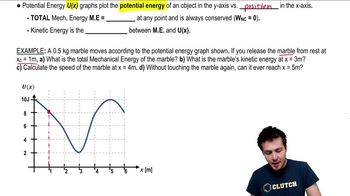
Potential energy is the energy stored in an object due to its position in a force field, such as gravitational or elastic fields. In this case, the potential energy U = 4y^3 J indicates that the energy depends on the position y of the particle along the y-axis. Understanding how potential energy varies with position is crucial for analyzing the forces acting on the particle.
추천 영상:
가이드 코스
07:24
Potential Energy Graphs

Force and Potential Energy Relationship

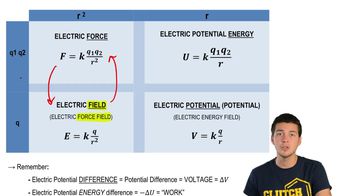
The force acting on a particle can be derived from the potential energy function using the relationship F = -dU/dy. This means that the force is equal to the negative gradient of the potential energy with respect to position. This concept is essential for determining the force at specific positions by calculating the derivative of the given potential energy function.
추천 영상:
가이드 코스
03:43
Relationships Between Force, Field, Energy, Potential

Calculating Derivatives

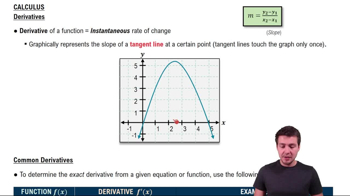
Calculating derivatives is a fundamental mathematical skill used to find rates of change. In the context of this problem, taking the derivative of the potential energy function U = 4y^3 with respect to y allows us to find the force at different positions. Mastery of differentiation techniques is necessary to accurately compute the force values at y = 0 m, 1 m, and 2 m.
추천 영상: