Ch 10: Interactions and Potential Energy
Knight Calc - Physics for Scientists and Engineers 5th Edition
Knight Calc5th EditionPhysics for Scientists and EngineersISBN: 9780137344796당신이 사용하는 게 아니라요?교과서 변경
10장, 문제 31

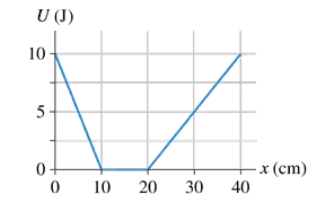
A system in which only one particle moves has the potential energy shown in FIGURE EX10.31. What is the x-component of the force on the particle at x = 5, 15, and 25 cm?

검증된 단계별 안내
1
Step 1: Recall the relationship between force and potential energy. The force acting on a particle is given by the negative gradient of the potential energy function: F_x = -dU/dx.
Step 2: Analyze the graph of potential energy (U) versus position (x). The graph shows linear segments where the slope of U changes. Identify the slope of U in the regions of interest: x = 5 cm, x = 15 cm, and x = 25 cm.
Step 3: For x = 5 cm, observe that this point lies in the region where U is increasing linearly from 0 to 10 J between x = 0 cm and x = 4 cm. Calculate the slope of this segment using the formula: slope = (change in U) / (change in x).
Step 4: For x = 15 cm, note that this point lies outside the range of the graph provided (x = 0 cm to x = 10 cm). Since the graph does not extend to x = 15 cm, the force at this position cannot be determined from the given data.
Step 5: For x = 25 cm, similarly, this point lies outside the range of the graph provided. The force at this position cannot be determined from the given data.

비슷한 문제에 대한 검증된 영상 답변:

이 영상 해법은 위 문제에 도움이 된다고 튜터들이 추천한 것입니다.
영상 길이:
7m
도움이 되었나요?

주요 개념

질문에 올바르게 답하기 위해 반드시 이해해야 하는 핵심 개념들은 다음과 같습니다.

Potential Energy (U)

Potential energy is the energy stored in a system due to the position of an object within a force field, such as gravitational or elastic fields. In the context of the given graph, potential energy is plotted against position, indicating how the energy changes as the particle moves. The shape of the graph reveals regions of stable and unstable equilibrium, which are crucial for understanding the forces acting on the particle.
추천 영상:
가이드 코스
06:35
Gravitational Potential Energy

Force and Potential Energy Relationship

The force acting on a particle can be derived from the potential energy function using the relationship F = -dU/dx, where F is the force and U is the potential energy. This means that the force is equal to the negative gradient of the potential energy with respect to position. By analyzing the slope of the potential energy graph at specific positions, one can determine the x-component of the force acting on the particle.
추천 영상:
가이드 코스
03:43
Relationships Between Force, Field, Energy, Potential

Equilibrium Points

Equilibrium points occur where the net force acting on a particle is zero, which corresponds to the local maxima or minima of the potential energy graph. At these points, the particle experiences no net force and can be in stable (minimum) or unstable (maximum) equilibrium. Understanding these points is essential for predicting the behavior of the particle as it moves through different positions along the x-axis.
추천 영상:
가이드 코스
10:13
Torque & Equilibrium