Ch 10: Interactions and Potential Energy
Knight Calc - Physics for Scientists and Engineers 5th Edition
Knight Calc5th EditionPhysics for Scientists and EngineersISBN: 9780137344796당신이 사용하는 게 아니라요?교과서 변경
10장, 문제 57

CALC A 2.6 kg block is attached to a horizontal rope that exerts a variable force Fx = (20 − 5x) N, where x is in m. The coefficient of kinetic friction between the block and the floor is 0.25. Initially the block is at rest at x = 0 m. What is the block's speed when it has been pulled to x = 4.0 m?

검증된 단계별 안내
1
Step 1: Identify the forces acting on the block. The forces include the applied force \( F_x = 20 - 5x \) (in Newtons), the kinetic friction force \( F_k = \mu_k F_N \), where \( \mu_k = 0.25 \) is the coefficient of kinetic friction, and \( F_N \) is the normal force. Since the block is on a horizontal surface, \( F_N = mg \), where \( m = 2.6 \ \text{kg} \) and \( g = 9.8 \ \text{m/s}^2 \).
Step 2: Calculate the work done by the applied force \( F_x \) as the block moves from \( x = 0 \ \text{m} \) to \( x = 4.0 \ \text{m} \). The work done by a variable force is given by \( W_{\text{applied}} = \int_{x_1}^{x_2} F_x \, dx \). Substitute \( F_x = 20 - 5x \) and integrate from \( x = 0 \) to \( x = 4.0 \).
Step 3: Calculate the work done by the friction force. The friction force is constant and given by \( F_k = \mu_k mg \). The work done by friction is \( W_{\text{friction}} = -F_k \cdot d \), where \( d = 4.0 \ \text{m} \) is the displacement. The negative sign indicates that friction opposes the motion.
Step 4: Use the work-energy principle to find the block's speed. The work-energy principle states that the net work done on the block is equal to the change in its kinetic energy: \( W_{\text{net}} = \Delta KE = \frac{1}{2}mv^2 - \frac{1}{2}m(0)^2 \). Here, \( W_{\text{net}} = W_{\text{applied}} + W_{\text{friction}} \). Solve for \( v \), the final speed of the block.
Step 5: Substitute the values of \( W_{\text{applied}} \), \( W_{\text{friction}} \), \( m \), and simplify the equation to find \( v \). This will give the block's speed after it has been pulled to \( x = 4.0 \ \text{m} \).

비슷한 문제에 대한 검증된 영상 답변:

이 영상 해법은 위 문제에 도움이 된다고 튜터들이 추천한 것입니다.
영상 길이:
12m
도움이 되었나요?

주요 개념

질문에 올바르게 답하기 위해 반드시 이해해야 하는 핵심 개념들은 다음과 같습니다.

Newton's Second Law of Motion

Newton's Second Law states that the acceleration of an object is directly proportional to the net force acting on it and inversely proportional to its mass. This principle is crucial for analyzing the motion of the block, as it allows us to relate the applied force, friction, and the resulting acceleration to determine the block's speed.
추천 영상:
가이드 코스
06:54
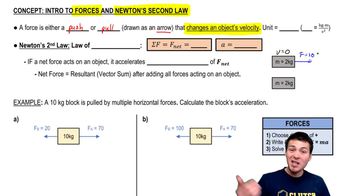
Intro to Forces & Newton's Second Law

Work-Energy Principle

The Work-Energy Principle states that the work done on an object is equal to the change in its kinetic energy. In this scenario, we can calculate the work done by the variable force and the work done against friction to find the block's final kinetic energy and, consequently, its speed at x=4.0 m.
추천 영상:
가이드 코스
04:10
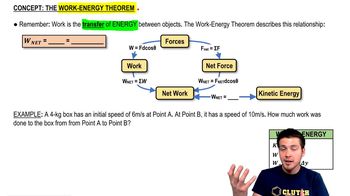
The Work-Energy Theorem

Frictional Force

Frictional force opposes the motion of an object and is calculated as the product of the coefficient of kinetic friction and the normal force. In this problem, understanding the frictional force is essential, as it affects the net force acting on the block and thus influences its acceleration and final speed.
추천 영상:
가이드 코스
08:11
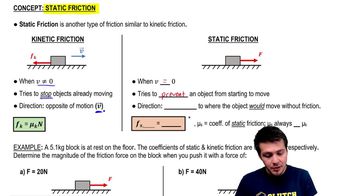
Static Friction & Equilibrium
관련 실천
교과서 질문

A sled starts from rest at the top of the frictionless, hemispherical, snow-covered hill shown in FIGURE P10.56. a. Find an expression for the sled's speed when it is at angle ϕ .

368
views

교과서 질문

A 1.0 kg mass that can move along the x-axis experiences the potential energy U = (x²−x) J, where x is in m. The mass has velocity vx = 3.0 m/s at position x = 1.0 m. At what position has it slowed to 1.0 m/s?

1768
views
교과서 질문

A system has potential energy U(x)=(10J)[1sin((3.14rad/m)x)]U(x) = (10 \, \(\text{J}\)) [1 - \(\sin\)((3.14 \, \(\text{rad/m}\)) x)] as a particle moves over the range 0 m x3 m0\(\text{ m }\]\le\) x\(\le\)3\(\text{ m}\). For each, is it a point of stable or unstable equilibrium?

2774
views
교과서 질문

The spring shown in FIGURE P10.54 is compressed 50 cm and used to launch a 100 kg physics student. The track is frictionless until it starts up the incline. The student's coefficient of kinetic friction on the 30° incline is 0.15. What is the student's speed just after losing contact with the spring?

<Image>

2814
views
교과서 질문

FIGURE 10.23 showed the potential-energy curve for the O2 molecule. Consider a molecule with the energy E1 shown in the figure. a. What is the maximum speed of an oxygen atom as it oscillates back and forth? Don't forget that the kinetic energy is the total kinetic energy of the system. The mass of an oxygen atom is 16 u, where 1u=1 atomic mass unit =1.66×10⁻²⁷ kg .

2633
views
교과서 질문

A 100 g particle experiences the one-dimensional, conservative force Fx shown in FIGURE P10.60. Let the zero of potential energy be at x = 0 m . What is the potential energy at x = 1.0, 2.0, 3.0, and 4.0 m? Hint: Use the definition of potential energy and the geometric interpretation of work.

2461
views