Ch 10: Interactions and Potential Energy
Knight Calc - Physics for Scientists and Engineers 5th Edition
Knight Calc5th EditionPhysics for Scientists and EngineersISBN: 9780137344796당신이 사용하는 게 아니라요?교과서 변경
10장, 문제 58

A 1.0 kg mass that can move along the x-axis experiences the potential energy U = (x²−x) J, where x is in m. The mass has velocity vx = 3.0 m/s at position x = 1.0 m. At what position has it slowed to 1.0 m/s?

검증된 단계별 안내
1
Step 1: Understand the problem. The mass is moving along the x-axis under the influence of a potential energy function U(x) = x² - x (in joules). The goal is to find the position x where the velocity of the mass slows down to 1.0 m/s, given that its initial velocity is 3.0 m/s at x = 1.0 m.
Step 2: Use the principle of conservation of mechanical energy. The total mechanical energy E is the sum of the kinetic energy K and the potential energy U. Write the total energy at the initial position x = 1.0 m: E = K₁ + U₁, where K₁ = (1/2)mvₓ² and U₁ = U(x).
Step 3: Write the total energy at the unknown position x where the velocity is 1.0 m/s. At this position, the total energy is E = K₂ + U₂, where K₂ = (1/2)mvₓ² and U₂ = U(x).
Step 4: Set the total energy at the initial position equal to the total energy at the unknown position, since energy is conserved. This gives the equation: (1/2)m(vₓ₁²) + U(x₁) = (1/2)m(vₓ₂²) + U(x₂). Substitute the given values for m, vₓ₁, vₓ₂, and U(x) to form the equation.
Step 5: Solve the equation for x₂. Substitute U(x) = x² - x into the equation and simplify. Rearrange the terms to isolate x₂, and solve the resulting quadratic equation to find the position where the velocity is 1.0 m/s.

비슷한 문제에 대한 검증된 영상 답변:

이 영상 해법은 위 문제에 도움이 된다고 튜터들이 추천한 것입니다.
영상 길이:
6m
도움이 되었나요?

주요 개념

질문에 올바르게 답하기 위해 반드시 이해해야 하는 핵심 개념들은 다음과 같습니다.

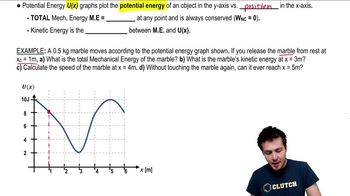
Potential Energy

Potential energy is the energy stored in an object due to its position in a force field, such as gravitational or elastic fields. In this case, the potential energy U is given as a function of position x, indicating how the energy changes as the mass moves along the x-axis. Understanding how potential energy varies with position is crucial for analyzing the motion and energy transformations of the mass.
추천 영상:
가이드 코스
07:24
Potential Energy Graphs

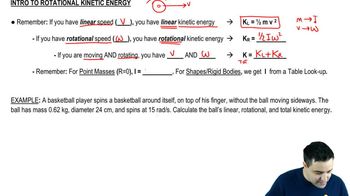
Kinetic Energy

Kinetic energy is the energy an object possesses due to its motion, calculated using the formula KE = 0.5 * m * v², where m is mass and v is velocity. As the mass moves and its speed changes, its kinetic energy will also change. This concept is essential for determining how the mass's speed affects its total mechanical energy when combined with potential energy.
추천 영상:
가이드 코스
06:07
Intro to Rotational Kinetic Energy

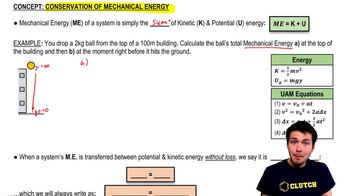
Conservation of Mechanical Energy

The principle of conservation of mechanical energy states that in a closed system with no non-conservative forces (like friction), the total mechanical energy (kinetic plus potential) remains constant. This principle allows us to relate the potential energy and kinetic energy at different positions, enabling us to find the position where the mass slows down to a specific speed by equating the total energy at two points.
추천 영상:
가이드 코스
06:24
Conservation Of Mechanical Energy
관련 실천
교과서 질문

A sled starts from rest at the top of the frictionless, hemispherical, snow-covered hill shown in FIGURE P10.56. a. Find an expression for the sled's speed when it is at angle ϕ .

368
views

교과서 질문

A system has potential energy U(x)=(10J)[1sin((3.14rad/m)x)]U(x) = (10 \, \(\text{J}\)) [1 - \(\sin\)((3.14 \, \(\text{rad/m}\)) x)] as a particle moves over the range 0 m x3 m0\(\text{ m }\]\le\) x\(\le\)3\(\text{ m}\). For each, is it a point of stable or unstable equilibrium?

2774
views
교과서 질문

FIGURE 10.23 showed the potential-energy curve for the O2 molecule. Consider a molecule with the energy E1 shown in the figure. a. What is the maximum speed of an oxygen atom as it oscillates back and forth? Don't forget that the kinetic energy is the total kinetic energy of the system. The mass of an oxygen atom is 16 u, where 1u=1 atomic mass unit =1.66×10⁻²⁷ kg .

2633
views
교과서 질문

CALC A 2.6 kg block is attached to a horizontal rope that exerts a variable force Fx = (20 − 5x) N, where x is in m. The coefficient of kinetic friction between the block and the floor is 0.25. Initially the block is at rest at x = 0 m. What is the block's speed when it has been pulled to x = 4.0 m?

3099
views
교과서 질문

A 100 g particle experiences the one-dimensional, conservative force Fx shown in FIGURE P10.60. Suppose the particle is shot to the right from x = 1.0 m with a speed of 25 m/s. Where is its turning point?

1784
views
교과서 질문

A 100 g particle experiences the one-dimensional, conservative force Fx shown in FIGURE P10.60. Let the zero of potential energy be at x = 0 m . What is the potential energy at x = 1.0, 2.0, 3.0, and 4.0 m? Hint: Use the definition of potential energy and the geometric interpretation of work.

2461
views