Ch 10: Interactions and Potential Energy
Knight Calc - Physics for Scientists and Engineers 5th Edition
Knight Calc5th EditionPhysics for Scientists and EngineersISBN: 9780137344796당신이 사용하는 게 아니라요?교과서 변경
10장, 문제 61a

A particle that can move along the x-axis is part of a system with potential energy U(x) = A/x2 − B/x where A and B are positive constants. Where are the particle's equilibrium positions?

검증된 단계별 안내
1
Step 1: Recall that equilibrium positions occur where the force acting on the particle is zero. The force is related to the potential energy by the equation F(x) = -dU(x)/dx. Begin by calculating the derivative of the given potential energy function U(x) = A/x^2 - B/x with respect to x.
Step 2: Differentiate U(x) with respect to x. Using the power rule for derivatives, the derivative of A/x^2 is -2A/x^3, and the derivative of -B/x is B/x^2. Combine these results to find dU(x)/dx = -2A/x^3 + B/x^2.
Step 3: Set the force equal to zero to find the equilibrium positions. This means solving the equation -dU(x)/dx = 0, or equivalently, -2A/x^3 + B/x^2 = 0.
Step 4: Factorize the equation to simplify. Rewrite the equation as (B/x^2) - (2A/x^3) = 0. Factor out 1/x^2, resulting in (1/x^2)(B - 2A/x) = 0. Since 1/x^2 cannot be zero, solve the remaining equation B - 2A/x = 0.
Step 5: Solve for x to find the equilibrium positions. Rearrange the equation B - 2A/x = 0 to isolate x, giving x = 2A/B. This is the position where the particle is in equilibrium.

비슷한 문제에 대한 검증된 영상 답변:

이 영상 해법은 위 문제에 도움이 된다고 튜터들이 추천한 것입니다.
영상 길이:
2m
도움이 되었나요?

주요 개념

질문에 올바르게 답하기 위해 반드시 이해해야 하는 핵심 개념들은 다음과 같습니다.

Potential Energy

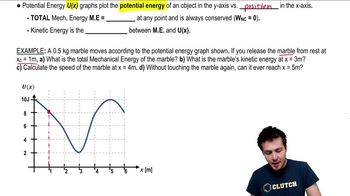
Potential energy is the energy stored in a system due to its position or configuration. In this case, the potential energy U(x) is defined as a function of the particle's position along the x-axis. Understanding how potential energy varies with position is crucial for analyzing the forces acting on the particle and determining its equilibrium positions.
추천 영상:
가이드 코스
07:24
Potential Energy Graphs

Equilibrium Position

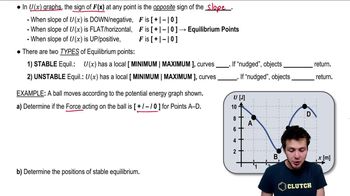
An equilibrium position occurs when the net force acting on a particle is zero, meaning the particle is in a state of balance. For a particle moving along the x-axis, this can be found by setting the derivative of the potential energy function U(x) to zero. At these points, the particle experiences no net force and can remain at rest or move with constant velocity.
추천 영상:
가이드 코스
05:50
Forces & Equilibrium Positions

Force from Potential Energy

The force acting on a particle can be derived from the potential energy function using the relationship F(x) = -dU/dx. This means that the force is equal to the negative gradient of the potential energy with respect to position. By calculating this derivative, one can identify the points where the force is zero, which correspond to the equilibrium positions of the particle.
추천 영상:
가이드 코스
07:24
Potential Energy Graphs
관련 실천
교과서 질문

CALC The potential energy for a particle that can move along the x-axis is U = Ax2 + B sin(πx/L), where A, B, and L are constants. What is the force on the particle at (a) x = 0, (b) x = L/2, and (c) x = L?

2200
views

교과서 질문

A system has potential energy U(x)=(10J)[1sin((3.14rad/m)x)]U(x) = (10 \, \(\text{J}\)) [1 - \(\sin\)((3.14 \, \(\text{rad/m}\)) x)] as a particle moves over the range 0 m x3 m0\(\text{ m }\]\le\) x\(\le\)3\(\text{ m}\). For each, is it a point of stable or unstable equilibrium?

2774
views
교과서 질문

CALC An object moving in the xy-plane is subjected to the force F=(2xyi^+x2j^)N\(\vec{F}\) = (2xy\,\(\hat{i}\) + x^2\,\(\hat{j}\))\,\(\text{N}\), where x and y are in m. The particle moves from the origin to the point with coordinates (a, b) by moving first along the x-axis to (a, 0), then parallel to the y-axis. How much work does the force do?

2458
views
교과서 질문

A 100 g particle experiences the one-dimensional, conservative force Fx shown in FIGURE P10.60. Suppose the particle is shot to the right from x = 1.0 m with a speed of 25 m/s. Where is its turning point?

1784
views
교과서 질문

A clever engineer designs a 'sprong' that obeys the force law Fx=−q(x−xeq)³ , where xeq is the equilibrium position of the end of the sprong and q is the sprong constant. For simplicity, we'll let xeq = 0 m .Then Fx = −qx³. Find an expression for the potential energy of a stretched or compressed sprong.

2152
views
교과서 질문

A 100 g particle experiences the one-dimensional, conservative force Fx shown in FIGURE P10.60. Let the zero of potential energy be at x = 0 m . What is the potential energy at x = 1.0, 2.0, 3.0, and 4.0 m? Hint: Use the definition of potential energy and the geometric interpretation of work.

2461
views