Ch 10: Interactions and Potential Energy
Knight Calc - Physics for Scientists and Engineers 5th Edition
Knight Calc5th EditionPhysics for Scientists and EngineersISBN: 9780137344796당신이 사용하는 게 아니라요?교과서 변경
10장, 문제 60b

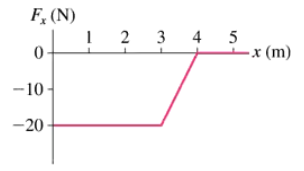
A 100 g particle experiences the one-dimensional, conservative force Fx shown in FIGURE P10.60. Suppose the particle is shot to the right from x = 1.0 m with a speed of 25 m/s. Where is its turning point?

검증된 단계별 안내
1
Step 1: Understand the concept of a turning point. A turning point occurs when the particle's kinetic energy is completely converted into potential energy, meaning its velocity becomes zero at that position.
Step 2: Use the principle of conservation of mechanical energy. The total mechanical energy (kinetic energy + potential energy) of the particle remains constant because the force is conservative. Write the equation: \( E_{total} = K + U \), where \( K \) is the kinetic energy and \( U \) is the potential energy.
Step 3: Calculate the initial total mechanical energy. The initial kinetic energy is given by \( K = \frac{1}{2} m v^2 \), where \( m \) is the mass of the particle (convert 100 g to kg: \( m = 0.1 \, \text{kg} \)) and \( v \) is its initial velocity (25 m/s). The initial potential energy \( U \) at \( x = 1.0 \, \text{m} \) can be determined from the force diagram or the potential energy function provided in the problem.
Step 4: Determine the potential energy \( U \) at different positions \( x \) using the relationship between force and potential energy: \( F_x = -\frac{dU}{dx} \). Integrate the force function \( F_x \) to find \( U(x) \), ensuring you account for the constant of integration based on the reference point.
Step 5: Solve for the turning point. At the turning point, the kinetic energy is zero, so \( E_{total} = U(x) \). Set the total mechanical energy equal to the potential energy function \( U(x) \) and solve for \( x \). This will give the position where the particle stops and reverses direction.

비슷한 문제에 대한 검증된 영상 답변:

이 영상 해법은 위 문제에 도움이 된다고 튜터들이 추천한 것입니다.
영상 길이:
5m
도움이 되었나요?

주요 개념

질문에 올바르게 답하기 위해 반드시 이해해야 하는 핵심 개념들은 다음과 같습니다.

Conservative Forces

Conservative forces are forces that do not dissipate energy and depend only on the position of an object. The work done by a conservative force on an object moving between two points is independent of the path taken. Examples include gravitational and elastic forces. In this context, the conservative force Fx will determine the potential energy associated with the particle's position.
추천 영상:
가이드 코스
06:43
Energy Conservation with Non-Conservative Forces

Kinetic and Potential Energy

Kinetic energy is the energy of an object due to its motion, calculated as KE = 1/2 mv², where m is mass and v is velocity. Potential energy, on the other hand, is the stored energy based on an object's position in a force field, such as gravitational or elastic potential energy. The conservation of mechanical energy principle states that the total mechanical energy (kinetic + potential) remains constant in a conservative system, allowing us to find the turning point of the particle.
추천 영상:
가이드 코스
06:35
Gravitational Potential Energy

Turning Point

The turning point of a particle in motion is the position where its velocity becomes zero, indicating a change in direction. At this point, all kinetic energy has been converted into potential energy. To find the turning point, one must analyze the energy conservation between kinetic and potential energy, using the initial speed and the potential energy function derived from the conservative force acting on the particle.
추천 영상:
가이드 코스
08:35
Angular Momentum of a Point Mass
관련 실천
교과서 질문

A 1.0 kg mass that can move along the x-axis experiences the potential energy U = (x²−x) J, where x is in m. The mass has velocity vx = 3.0 m/s at position x = 1.0 m. At what position has it slowed to 1.0 m/s?

1768
views

교과서 질문

CALC The potential energy for a particle that can move along the x-axis is U = Ax2 + B sin(πx/L), where A, B, and L are constants. What is the force on the particle at (a) x = 0, (b) x = L/2, and (c) x = L?

2200
views
교과서 질문

A system has potential energy U(x)=(10J)[1sin((3.14rad/m)x)]U(x) = (10 \, \(\text{J}\)) [1 - \(\sin\)((3.14 \, \(\text{rad/m}\)) x)] as a particle moves over the range 0 m x3 m0\(\text{ m }\]\le\) x\(\le\)3\(\text{ m}\). For each, is it a point of stable or unstable equilibrium?

2774
views
교과서 질문

A particle that can move along the x-axis is part of a system with potential energy U(x) = A/x2 − B/x where A and B are positive constants. Where are the particle's equilibrium positions?

2209
views
교과서 질문

A clever engineer designs a 'sprong' that obeys the force law Fx=−q(x−xeq)³ , where xeq is the equilibrium position of the end of the sprong and q is the sprong constant. For simplicity, we'll let xeq = 0 m .Then Fx = −qx³. Find an expression for the potential energy of a stretched or compressed sprong.

2152
views
교과서 질문

A 100 g particle experiences the one-dimensional, conservative force Fx shown in FIGURE P10.60. Let the zero of potential energy be at x = 0 m . What is the potential energy at x = 1.0, 2.0, 3.0, and 4.0 m? Hint: Use the definition of potential energy and the geometric interpretation of work.

2461
views