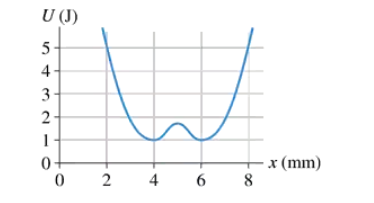
FIGURE EX10.28 shows the potential-energy diagram for a 500 g particle as it moves along the x-axis. Suppose the particle's mechanical energy is 12 J. Where are the particle's turning points?
Ch 10: Interactions and Potential Energy
10장, 문제 27
In FIGURE EX10.27, what is the maximum speed of a 2.0 g particle that oscillates between x = 2.0 mm and x = 8.0 mm

검증된 단계별 안내1
Determine the amplitude of the oscillation. The amplitude is the maximum displacement from the equilibrium position. In this case, the particle oscillates between x = 2.0 mm and x = 8.0 mm, so the equilibrium position is the midpoint: \( x_{eq} = \frac{2.0 \text{ mm} + 8.0 \text{ mm}}{2} \). The amplitude \( A \) is then \( A = 8.0 \text{ mm} - x_{eq} \).
Recall the formula for the maximum speed of a particle in simple harmonic motion: \( v_{max} = \omega A \), where \( \omega \) is the angular frequency and \( A \) is the amplitude. To calculate \( v_{max} \), we need to find \( \omega \).
The angular frequency \( \omega \) is related to the mass \( m \) and the spring constant \( k \) by the formula \( \omega = \sqrt{\frac{k}{m}} \). If the spring constant \( k \) is not provided, it must be determined or assumed based on additional context.
Substitute the values of \( \omega \) and \( A \) into the formula \( v_{max} = \omega A \). Ensure that the amplitude \( A \) is converted to meters (SI units) before performing the calculation.
Simplify the expression to find the maximum speed \( v_{max} \). Remember to keep the units consistent throughout the calculation.

비슷한 문제에 대한 검증된 영상 답변:
이 영상 해법은 위 문제에 도움이 된다고 튜터들이 추천한 것입니다.
영상 길이:
6m도움이 되었나요?
주요 개념
질문에 올바르게 답하기 위해 반드시 이해해야 하는 핵심 개념들은 다음과 같습니다.
Simple Harmonic Motion (SHM)
Simple Harmonic Motion is a type of periodic motion where an object oscillates around an equilibrium position. The motion is characterized by a restoring force proportional to the displacement from the equilibrium, leading to sinusoidal motion. In this context, the particle's oscillation between two positions indicates it is undergoing SHM.
추천 영상:
가이드 코스
Simple Harmonic Motion of Pendulums
Maximum Speed in SHM
In Simple Harmonic Motion, the maximum speed of an oscillating particle occurs as it passes through the equilibrium position. This speed can be calculated using the formula v_max = ωA, where ω is the angular frequency and A is the amplitude of the motion. Understanding this relationship is crucial for determining the particle's maximum speed.
추천 영상:
가이드 코스
Speed Distribution & Special Speeds of Ideal Gases
Amplitude
Amplitude in the context of oscillation refers to the maximum displacement of the particle from its equilibrium position. It is half the distance between the maximum and minimum positions of the oscillation. For the given problem, the amplitude can be calculated as half the difference between the two positions (8.0 mm and 2.0 mm), which is essential for finding the maximum speed.
추천 영상:
가이드 코스
Amplitude Decay in an LRC Circuit
관련 실천
교과서 질문
2529
views
교과서 질문
A system in which only one particle moves has the potential energy shown in FIGURE EX10.31. What is the x-component of the force on the particle at x = 5, 15, and 25 cm?
2792
views
교과서 질문
In FIGURE EX10.26, What minimum speed does a 100 g particle need at point B to reach point A?
634
views
교과서 질문
FIGURE EX10.24 is the potential-energy diagram for a 500 g particle that is released from rest at A. What are the particle's speeds at B, C, and D?
2344
views
교과서 질문
In FIGURE EX10.28, what is the maximum speed a 200 g particle could have at x = 2.0 m and never reach x = 6.0 m?
2319
views
교과서 질문
FIGURE EX10.25 is the potential-energy diagram for a 20 g particle that is released from rest at x = 1.0 m. What is the particle's maximum speed? At what position does it have this speed?
2955
views