
Ch 11: Impulse and Momentum
Knight Calc - Physics for Scientists and Engineers 5th Edition
Knight Calc5th EditionPhysics for Scientists and EngineersISBN: 9780137344796당신이 사용하는 게 아니라요?교과서 변경
11장, 문제 24b

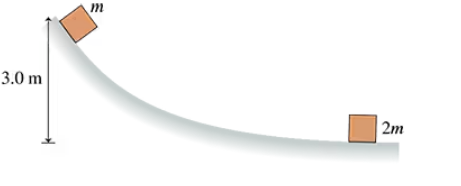
A package of mass m is released from rest at a warehouse loading dock and slides down the 3.0-m-high, frictionless chute of FIGURE EX11.24 to a waiting truck. Unfortunately, the truck driver went on a break without having removed the previous package, of mass 2m, from the bottom of the chute. Suppose the collision between the packages is perfectly elastic. To what height does the package of mass m rebound?

검증된 단계별 안내
1
Step 1: Calculate the velocity of the package of mass m at the bottom of the chute using the principle of conservation of energy. The potential energy at the top is converted into kinetic energy at the bottom. Use the formula: \( v = \sqrt{2gh} \), where \( g \) is the acceleration due to gravity and \( h \) is the height of the chute.
Step 2: Analyze the collision between the two packages. Since the collision is perfectly elastic, both momentum and kinetic energy are conserved. Write the equations for conservation of momentum: \( m v + 2m \cdot 0 = m v_1 + 2m v_2 \), and conservation of kinetic energy: \( \frac{1}{2} m v^2 = \frac{1}{2} m v_1^2 + \frac{1}{2} (2m) v_2^2 \).
Step 3: Solve the system of equations from Step 2 to find the velocities \( v_1 \) (velocity of mass m after collision) and \( v_2 \) (velocity of mass 2m after collision).
Step 4: Determine the rebound height of the package of mass m using its velocity \( v_1 \) after the collision. Use the conservation of energy principle again, where the kinetic energy at the bottom is converted back into potential energy at the rebound height. The formula is \( h_{rebound} = \frac{v_1^2}{2g} \).
Step 5: Substitute the values obtained into the equations to express the rebound height \( h_{rebound} \) in terms of the given quantities \( m \), \( g \), and \( h \).

비슷한 문제에 대한 검증된 영상 답변:

이 영상 해법은 위 문제에 도움이 된다고 튜터들이 추천한 것입니다.
도움이 되었나요?

주요 개념

질문에 올바르게 답하기 위해 반드시 이해해야 하는 핵심 개념들은 다음과 같습니다.

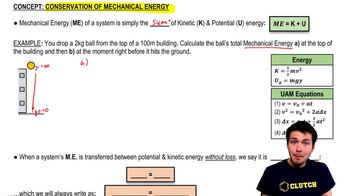
Conservation of Energy

The principle of conservation of energy states that in a closed system, the total energy remains constant. In this scenario, the potential energy of the package of mass m at the top of the chute is converted into kinetic energy as it slides down. The initial potential energy can be calculated using the formula PE = mgh, where h is the height, and this energy will determine the speed of the package just before the collision.
추천 영상:
가이드 코스
06:24
Conservation Of Mechanical Energy

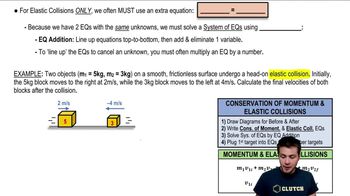
Elastic Collision

An elastic collision is one in which both momentum and kinetic energy are conserved. In this problem, when the package of mass m collides with the stationary package of mass 2m, the conservation laws will allow us to calculate the final velocities of both packages after the collision. This is crucial for determining how high the lighter package rebounds after the impact.
추천 영상:
가이드 코스
08:56
Intro To Elastic Collisions

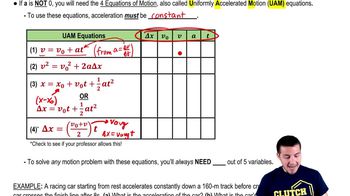
Kinematics of Motion

Kinematics involves the study of motion without considering the forces that cause it. After the collision, the rebound height of the package of mass m can be determined using kinematic equations. Specifically, we can use the relationship between the final velocity after the collision and the maximum height reached, applying the formula v^2 = 2gh, where v is the velocity just after the collision and h is the height.
추천 영상:
가이드 코스
08:25
Kinematics Equations