Ch 11: Impulse and Momentum
Knight Calc - Physics for Scientists and Engineers 5th Edition
Knight Calc5th EditionPhysics for Scientists and EngineersISBN: 9780137344796당신이 사용하는 게 아니라요?교과서 변경
11장, 문제 22

A proton is traveling to the right at 2.0 x 10⁷ m/s. It has a head-on perfectly elastic collision with a carbon atom. The mass of the carbon atom is 12 times the mass of the proton. What are the speed and direction of each after the collision?

검증된 단계별 안내
1
Step 1: Recognize that this is a perfectly elastic collision, meaning both momentum and kinetic energy are conserved. Let the mass of the proton be mₚ and the mass of the carbon atom be mₐ = 12mₚ. Let the initial velocity of the proton be vₚ₁ = 2.0 × 10⁷ m/s, and the initial velocity of the carbon atom be vₐ₁ = 0 m/s (since it is initially at rest).
Step 2: Write the equation for conservation of momentum: mₚvₚ₁ + mₐvₐ₁ = mₚvₚ₂ + mₐvₐ₂, where vₚ₂ and vₐ₂ are the final velocities of the proton and carbon atom, respectively. Substitute the known values: mₚ(2.0 × 10⁷) + 12mₚ(0) = mₚvₚ₂ + 12mₚvₐ₂.
Step 3: Simplify the momentum equation by canceling out mₚ (since it is common to all terms): 2.0 × 10⁷ = vₚ₂ + 12vₐ₂. This is the first equation relating vₚ₂ and vₐ₂.
Step 4: Write the equation for conservation of kinetic energy: (1/2)mₚvₚ₁² + (1/2)mₐvₐ₁² = (1/2)mₚvₚ₂² + (1/2)mₐvₐ₂². Substitute the known values: (1/2)mₚ(2.0 × 10⁷)² + (1/2)(12mₚ)(0)² = (1/2)mₚvₚ₂² + (1/2)(12mₚ)vₐ₂².
Step 5: Simplify the kinetic energy equation by canceling out (1/2)mₚ: (2.0 × 10⁷)² = vₚ₂² + 12vₐ₂². This is the second equation relating vₚ₂ and vₐ₂. Solve the system of equations from Step 3 and Step 5 to find the final velocities vₚ₂ and vₐ₂. The direction of each particle can be determined from the signs of their velocities.

비슷한 문제에 대한 검증된 영상 답변:

이 영상 해법은 위 문제에 도움이 된다고 튜터들이 추천한 것입니다.
영상 길이:
15m

주요 개념

질문에 올바르게 답하기 위해 반드시 이해해야 하는 핵심 개념들은 다음과 같습니다.

Conservation of Momentum

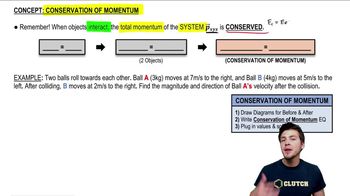
In a collision, the total momentum of a system remains constant if no external forces act on it. This principle allows us to relate the velocities of the colliding objects before and after the collision. For a perfectly elastic collision, the momentum before the collision equals the momentum after the collision, which can be expressed mathematically as m1*v1 + m2*v2 = m1*v1' + m2*v2', where m is mass and v is velocity.
추천 영상:
가이드 코스
05:58
Conservation Of Momentum

Elastic Collision

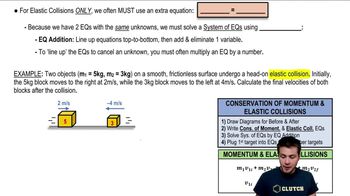
An elastic collision is one in which both momentum and kinetic energy are conserved. In such collisions, the objects bounce off each other without any loss of kinetic energy. This is crucial for solving the problem, as it allows us to use both conservation laws to find the final velocities of the proton and the carbon atom after their interaction.
추천 영상:
가이드 코스
08:56
Intro To Elastic Collisions

Mass Ratio and Velocity Relationship

The mass ratio between colliding objects significantly affects their post-collision velocities. In this scenario, the carbon atom's mass is 12 times that of the proton, which means it will have a much smaller change in velocity compared to the proton. Understanding how mass influences the final speeds and directions of the objects is essential for accurately calculating their outcomes after the collision.
추천 영상:
가이드 코스
04:12
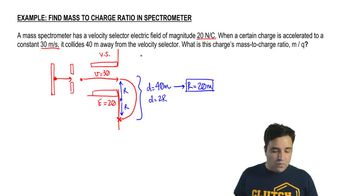
Find Mass-to-Charge Ratio in Spectrometer
관련 실천