
Ch 13: Newton's Theory of Gravity
Knight Calc - Physics for Scientists and Engineers 5th Edition
Knight Calc5th EditionPhysics for Scientists and EngineersISBN: 9780137344796당신이 사용하는 게 아니라요?교과서 변경
13장, 문제 11

A recently discovered extrasolar planet appears to be rockier and denser than earth. It is 16 times as massive as earth, but its diameter is only twice that of earth. What is the free-fall acceleration on the surface of this planet?

검증된 단계별 안내
1
Step 1: Recall the formula for gravitational acceleration on the surface of a planet: g=(GM)R2, where G is the gravitational constant, M is the mass of the planet, and R is the radius of the planet.
Step 2: Compare the mass and diameter of the extrasolar planet to Earth. The mass of the planet is 16 times Earth's mass (M=16Me), and its diameter is twice Earth's diameter. Since the radius is half the diameter, the radius of the planet is R=2Re.
Step 3: Substitute the values for mass and radius into the formula for gravitational acceleration. Replace M with 16Me and R with 2Re: g=(G(16Me))(2Re)2.
Step 4: Simplify the expression. The denominator becomes (2Re)2=4Re2. The formula now becomes: g=(16GMe)4Re2.
Step 5: Further simplify the fraction. Divide the numerator and denominator by 4: g=(4GMe)Re2. Recognize that this is 4 times Earth's gravitational acceleration, ge. Therefore, the free-fall acceleration on the surface of the planet is 4 times Earth's gravity.

비슷한 문제에 대한 검증된 영상 답변:

이 영상 해법은 위 문제에 도움이 된다고 튜터들이 추천한 것입니다.
영상 길이:
2m
도움이 되었나요?

주요 개념

질문에 올바르게 답하기 위해 반드시 이해해야 하는 핵심 개념들은 다음과 같습니다.

Gravitational Acceleration

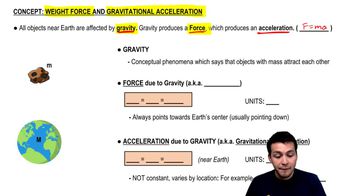
Gravitational acceleration is the acceleration experienced by an object due to the gravitational force exerted by a massive body, such as a planet. It is commonly denoted by 'g' and varies depending on the mass of the planet and the distance from its center. The formula to calculate gravitational acceleration at the surface of a planet is g = G * M / R², where G is the gravitational constant, M is the mass of the planet, and R is its radius.
추천 영상:
07:32
Weight Force & Gravitational Acceleration

Mass and Density Relationship

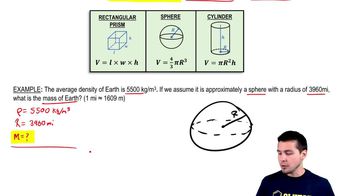
The mass of an object is a measure of the amount of matter it contains, while density is defined as mass per unit volume. For a planet, if its mass increases while its volume does not increase proportionally, its density will also increase. In this case, the planet's mass is 16 times that of Earth, and its diameter is only twice that of Earth, indicating a higher density than Earth.
추천 영상:
04:33
Problems with Mass, Volume, & Density

Volume and Radius of a Sphere

The volume of a sphere is calculated using the formula V = (4/3)πR³, where R is the radius. Since the diameter is twice that of Earth, the radius of the new planet is also twice that of Earth. This relationship is crucial for determining the volume and subsequently the density of the planet, which affects the calculation of gravitational acceleration.
추천 영상:
05:21
Volume Thermal Expansion