Ch 13: Newton's Theory of Gravity
Knight Calc - Physics for Scientists and Engineers 5th Edition
Knight Calc5th EditionPhysics for Scientists and EngineersISBN: 9780137344796당신이 사용하는 게 아니라요?교과서 변경
13장, 문제 12

Asteroid 253 Mathilde is one of several that have been visited by space probes. This asteroid is roughly spherical with a diameter of 53 km. The free-fall acceleration at the surface is 9.9 ✕ 10-3 m/s2. What is the asteroid's mass?

검증된 단계별 안내
1
Start by recalling the formula for gravitational acceleration: g = \(\frac{G \cdot M}{r^2}\), where g is the gravitational acceleration, G is the gravitational constant (6.674 \(\times\) 10^{-11} \ \(\text{m}\)^3 \(\text{kg}\)^{-1} \(\text{s}\)^{-2}), M is the mass of the asteroid, and r is the radius of the asteroid.
Rearrange the formula to solve for the mass M: M = \(\frac{g \cdot r^2}{G}\).
Determine the radius of the asteroid. Since the diameter is given as 53 km, the radius r is half of the diameter: r = \(\frac{53}{2}\) \ \(\text{km}\) = 26.5 \ \(\text{km}\) = 26,500 \ \(\text{m}\).
Substitute the known values into the formula: g = 9.9 \(\times\) 10^{-3} \ \(\text{m/s}\)^2, r = 26,500 \ \(\text{m}\), and G = 6.674 \(\times\) 10^{-11} \ \(\text{m}\)^3 \(\text{kg}\)^{-1} \(\text{s}\)^{-2}. The equation becomes M = \(\frac{(9.9 \times 10^{-3}\)) \(\cdot\) (26,500)^2}{6.674 \(\times\) 10^{-11}}.
Simplify the expression to calculate the mass M. Ensure that all units are consistent and perform the arithmetic operations carefully to find the asteroid's mass.

비슷한 문제에 대한 검증된 영상 답변:

이 영상 해법은 위 문제에 도움이 된다고 튜터들이 추천한 것입니다.
영상 길이:
3m
도움이 되었나요?

주요 개념

질문에 올바르게 답하기 위해 반드시 이해해야 하는 핵심 개념들은 다음과 같습니다.

Gravitational Force

Gravitational force is the attractive force between two masses. It is described by Newton's law of universal gravitation, which states that the force is proportional to the product of the two masses and inversely proportional to the square of the distance between their centers. This concept is crucial for understanding how the mass of an object can be determined from the gravitational acceleration it experiences.
추천 영상:
05:41
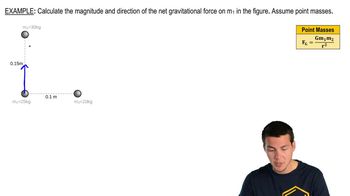
Gravitational Forces in 2D

Free-Fall Acceleration

Free-fall acceleration is the acceleration of an object due solely to the force of gravity, without any other forces acting on it. On the surface of an astronomical body, this acceleration can be calculated using the formula g = G * M / r², where G is the gravitational constant, M is the mass of the body, and r is its radius. In this case, the free-fall acceleration at the surface of the asteroid is given as 9.9 × 10⁻³ m/s².
추천 영상:
08:36
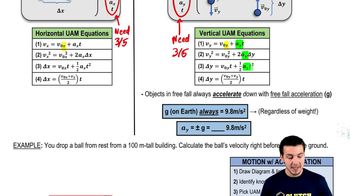
Vertical Motion & Free Fall

Mass Calculation

To find the mass of an object using free-fall acceleration, we can rearrange the formula for gravitational acceleration. By substituting the known values of g (free-fall acceleration) and r (radius of the asteroid), we can solve for M (mass). This calculation is essential for determining the mass of asteroid 253 Mathilde based on its size and the gravitational acceleration experienced at its surface.
추천 영상:
20:32
Mass Spectrometers