Ch 13: Newton's Theory of Gravity
Knight Calc - Physics for Scientists and Engineers 5th Edition
Knight Calc5th EditionPhysics for Scientists and EngineersISBN: 9780137344796당신이 사용하는 게 아니라요?교과서 변경
13장, 문제 17

A rocket is launched straight up from the earth's surface at a speed of 15,000 m/s. What is its speed when it is very far away from the earth?

검증된 단계별 안내
1
Step 1: Recognize that this problem involves the conservation of energy principle. The rocket's initial kinetic energy and gravitational potential energy will be converted into its final kinetic energy when it is very far away from the Earth.
Step 2: Write the total mechanical energy equation. The initial total energy is the sum of the rocket's kinetic energy and gravitational potential energy: \( E_{initial} = \frac{1}{2}mv^2 - \frac{GMm}{R} \), where \( v \) is the initial velocity, \( G \) is the gravitational constant, \( M \) is the Earth's mass, \( R \) is the Earth's radius, and \( m \) is the rocket's mass.
Step 3: At a very far distance from the Earth, the gravitational potential energy approaches zero, and the rocket's final total energy is purely kinetic: \( E_{final} = \frac{1}{2}mv_{final}^2 \).
Step 4: Apply the conservation of energy principle: \( E_{initial} = E_{final} \). Substitute the expressions for \( E_{initial} \) and \( E_{final} \): \( \frac{1}{2}mv^2 - \frac{GMm}{R} = \frac{1}{2}mv_{final}^2 \).
Step 5: Simplify the equation to solve for \( v_{final} \): \( v_{final} = \sqrt{v^2 - \frac{2GM}{R}} \). Substitute the given values for \( v \), \( G \), \( M \), and \( R \) to calculate the final speed.

비슷한 문제에 대한 검증된 영상 답변:

이 영상 해법은 위 문제에 도움이 된다고 튜터들이 추천한 것입니다.
영상 길이:
11m
도움이 되었나요?

주요 개념

질문에 올바르게 답하기 위해 반드시 이해해야 하는 핵심 개념들은 다음과 같습니다.

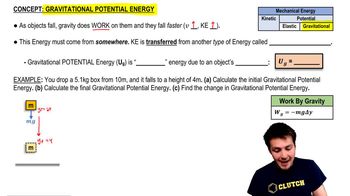
Kinetic Energy and Gravitational Potential Energy

In the context of a rocket launch, kinetic energy is the energy of motion, while gravitational potential energy is the energy stored due to an object's position in a gravitational field. As the rocket ascends, its kinetic energy decreases while its gravitational potential energy increases until it reaches a point where the gravitational influence of the Earth is negligible.
추천 영상:
가이드 코스
06:35
Gravitational Potential Energy

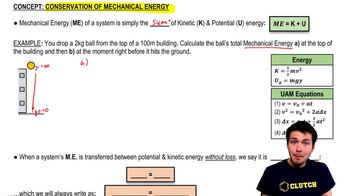
Conservation of Energy

The principle of conservation of energy states that the total energy in a closed system remains constant. For the rocket, the initial kinetic energy at launch will convert into gravitational potential energy as it rises, and when it is far from Earth, this energy will primarily be kinetic, allowing us to calculate its speed at that point.
추천 영상:
가이드 코스
06:24
Conservation Of Mechanical Energy

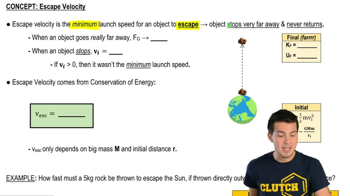
Escape Velocity

Escape velocity is the minimum speed needed for an object to break free from a celestial body's gravitational pull without further propulsion. For Earth, this speed is approximately 11,186 m/s. Since the rocket's initial speed exceeds this threshold, it will continue to move away from Earth, and its speed will be determined by the conservation of energy as it moves into space.
추천 영상:
가이드 코스
7:27
Escape Velocity