Ch 14: Fluids and Elasticity
Knight Calc - Physics for Scientists and Engineers 5th Edition
Knight Calc5th EditionPhysics for Scientists and EngineersISBN: 9780137344796당신이 사용하는 게 아니라요?교과서 변경
14장, 문제 58

A tree loses water to the air by the process of transpiration at the rate of 110 g/h. This water is replaced by the upward flow of sap through vessels in the trunk. If the trunk contains 2000 vessels, each 100 μm in diameter, what is the upward speed in mm/s of the sap in each vessel? The density of tree sap is 1040 kg/m³.

검증된 단계별 안내
1
Step 1: Convert the rate of water loss from grams per hour (g/h) to kilograms per second (kg/s). Since 1 gram = 0.001 kilograms and 1 hour = 3600 seconds, use the conversion factor to calculate the mass flow rate in kg/s.
Step 2: Calculate the volumetric flow rate of sap in m³/s using the formula \( Q = \frac{\text{mass flow rate}}{\text{density}} \), where the density of sap is given as 1040 kg/m³.
Step 3: Determine the cross-sectional area of a single vessel using the formula \( A = \pi r^2 \), where \( r \) is the radius of the vessel. The diameter is given as 100 μm, so the radius is half of that (50 μm or 50 × 10⁻⁶ m).
Step 4: Calculate the total cross-sectional area of all 2000 vessels by multiplying the area of one vessel by the number of vessels.
Step 5: Find the upward speed of sap in each vessel using the formula \( v = \frac{Q}{A_{\text{total}}} \), where \( Q \) is the volumetric flow rate and \( A_{\text{total}} \) is the total cross-sectional area. Convert the speed from m/s to mm/s by multiplying by 1000.

비슷한 문제에 대한 검증된 영상 답변:

이 영상 해법은 위 문제에 도움이 된다고 튜터들이 추천한 것입니다.
영상 길이:
9m

주요 개념

질문에 올바르게 답하기 위해 반드시 이해해야 하는 핵심 개념들은 다음과 같습니다.

Transpiration

Transpiration is the process by which water vapor is released from plant leaves into the atmosphere. It plays a crucial role in the water cycle and helps in nutrient transport within the plant. The rate of transpiration can be influenced by environmental factors such as temperature, humidity, and wind speed.
추천 영상:
가이드 코스
05:51
Refraction at Spherical Surfaces

Fluid Dynamics

Fluid dynamics is the study of the behavior of fluids (liquids and gases) in motion. In this context, it helps us understand how sap moves through the vessels in the tree trunk. The principles of fluid dynamics, including flow rate and cross-sectional area, are essential for calculating the speed of sap in the vessels.
추천 영상:
가이드 코스
08:12
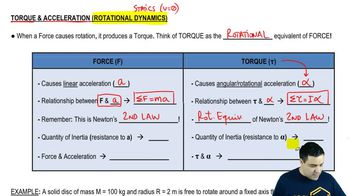
Torque & Acceleration (Rotational Dynamics)

Cross-sectional Area

The cross-sectional area of a vessel is the area of a slice taken perpendicular to the flow direction. It is crucial for determining the flow rate of sap in the vessels. For circular vessels, the area can be calculated using the formula A = π(d/2)², where d is the diameter. This area directly affects the speed of the fluid moving through the vessel.
추천 영상:
가이드 코스
08:10
Calculating the Vector (Cross) Product Using Components