Ch 14: Fluids and Elasticity
Knight Calc - Physics for Scientists and Engineers 5th Edition
Knight Calc5th EditionPhysics for Scientists and EngineersISBN: 9780137344796당신이 사용하는 게 아니라요?교과서 변경
14장, 문제 60

Water from a vertical pipe emerges as a 10-cm-diameter cylinder and falls straight down 7.5 m into a bucket. The water exits the pipe with a speed of 2.0 m/s. What is the diameter of the column of water as it hits the bucket?

검증된 단계별 안내
1
Step 1: Begin by analyzing the problem. The water exits the pipe with an initial speed of 2.0 m/s and falls vertically downward for a distance of 7.5 m. The goal is to determine the diameter of the water column when it reaches the bucket.
Step 2: Use the principle of conservation of mass, which states that the mass flow rate of water remains constant throughout its motion. The mass flow rate is given by \( \dot{m} = \rho A v \), where \( \rho \) is the density of water, \( A \) is the cross-sectional area, and \( v \) is the velocity.
Step 3: Calculate the velocity of the water as it hits the bucket using the kinematic equation \( v_f = \sqrt{v_i^2 + 2 g h} \), where \( v_i \) is the initial velocity (2.0 m/s), \( g \) is the acceleration due to gravity (9.8 m/s²), and \( h \) is the height (7.5 m).
Step 4: Relate the cross-sectional areas at the pipe and the bucket using the continuity equation \( A_1 v_1 = A_2 v_2 \). Here, \( A_1 \) is the area of the water column at the pipe, \( v_1 \) is the velocity at the pipe, \( A_2 \) is the area of the water column at the bucket, and \( v_2 \) is the velocity at the bucket.
Step 5: Solve for the diameter of the water column at the bucket using \( A = \pi (d/2)^2 \). Rearrange the continuity equation to find \( d_2 \), the diameter at the bucket, and substitute the values for \( v_1 \), \( v_2 \), and \( d_1 \) (10 cm).

비슷한 문제에 대한 검증된 영상 답변:

이 영상 해법은 위 문제에 도움이 된다고 튜터들이 추천한 것입니다.
영상 길이:
7m
도움이 되었나요?

주요 개념

질문에 올바르게 답하기 위해 반드시 이해해야 하는 핵심 개념들은 다음과 같습니다.

Continuity Equation

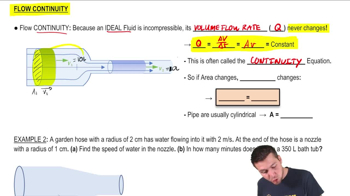
The Continuity Equation states that for an incompressible fluid flowing through a pipe, the product of the cross-sectional area and the fluid velocity remains constant. This principle implies that if the diameter of the pipe changes, the velocity of the fluid must adjust accordingly to maintain a constant flow rate.
추천 영상:
가이드 코스
11:08
Flow Continuity

Bernoulli's Principle

Bernoulli's Principle relates the pressure, velocity, and height of a fluid in steady flow. It indicates that an increase in the fluid's speed occurs simultaneously with a decrease in pressure or potential energy. This principle is crucial for understanding how the speed of water changes as it exits the pipe and falls into the bucket.
추천 영상:
가이드 코스
14:47
Diffraction with Huygen's Principle

Kinematic Equations of Motion

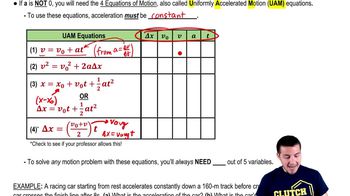
Kinematic equations describe the motion of objects under constant acceleration. In this scenario, the water falling from the pipe experiences gravitational acceleration. These equations can be used to determine the final velocity of the water just before it hits the bucket, which is essential for calculating the diameter of the water column upon impact.
추천 영상:
가이드 코스
08:25
Kinematics Equations