
Ch 14: Fluids and Elasticity
Knight Calc - Physics for Scientists and Engineers 5th Edition
Knight Calc5th EditionPhysics for Scientists and EngineersISBN: 9780137344796당신이 사용하는 게 아니라요?교과서 변경
14장, 문제 47b

An aquarium of length L, width (front to back) W, and depth D is filled to the top with liquid of density ρ. Find an expression for the force of the liquid on the front window of the aquarium.

검증된 단계별 안내
1
The force exerted by a liquid on a surface is due to the pressure of the liquid. The pressure at a depth \( h \) in a liquid is given by \( P = \rho g h \), where \( \rho \) is the density of the liquid, \( g \) is the acceleration due to gravity, and \( h \) is the depth below the surface.
The pressure varies with depth, so we need to calculate the total force by integrating the pressure over the area of the front window. The front window has an area \( A = W \cdot D \), where \( W \) is the width and \( D \) is the depth.
Consider a horizontal strip of the front window at a depth \( h \) with a small thickness \( dh \). The pressure at this depth is \( P = \rho g h \), and the force on this strip is \( dF = P \cdot dA \), where \( dA = W \cdot dh \).
Substitute \( P \) and \( dA \) into the expression for \( dF \): \( dF = (\rho g h) (W \cdot dh) = \rho g W h \cdot dh \). To find the total force, integrate \( dF \) over the depth of the window from \( h = 0 \) to \( h = D \).
The total force is \( F = \int_0^D \rho g W h \; dh \). Solve the integral: \( F = \rho g W \int_0^D h \; dh = \rho g W \left[ \frac{h^2}{2} \right]_0^D = \frac{1}{2} \rho g W D^2 \). This is the expression for the force of the liquid on the front window of the aquarium.

비슷한 문제에 대한 검증된 영상 답변:

이 영상 해법은 위 문제에 도움이 된다고 튜터들이 추천한 것입니다.
영상 길이:
5m
도움이 되었나요?

주요 개념

질문에 올바르게 답하기 위해 반드시 이해해야 하는 핵심 개념들은 다음과 같습니다.

Hydrostatic Pressure

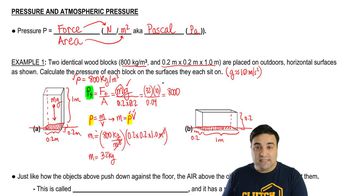
Hydrostatic pressure is the pressure exerted by a fluid at rest due to the force of gravity. It increases with depth and is given by the formula P = pgh, where P is the pressure, p is the fluid density, g is the acceleration due to gravity, and h is the depth of the fluid. This concept is crucial for understanding how pressure varies in a liquid and how it affects forces on submerged surfaces.
추천 영상:
가이드 코스
17:04
Pressure and Atmospheric Pressure

Force on a Surface

The force exerted by a fluid on a surface is calculated by integrating the pressure over the area of the surface. For a vertical surface like the front window of the aquarium, the total force can be found using F = ∫ P dA, where dA is an infinitesimal area element. This concept is essential for determining how the pressure from the liquid translates into a net force acting on the aquarium's window.
추천 영상:
가이드 코스
09:18
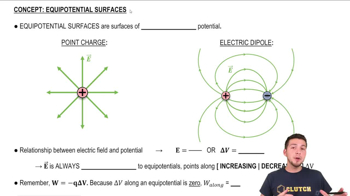
Equipotential Surfaces

Center of Pressure

The center of pressure is the point on a submerged surface where the resultant pressure force acts. It is not necessarily at the centroid of the area, especially for vertical surfaces, and is influenced by the distribution of pressure across the surface. Understanding the center of pressure is important for analyzing stability and structural integrity in fluid mechanics, particularly in applications like aquariums.
추천 영상:
가이드 코스
17:04
Pressure and Atmospheric Pressure
관련 실천
교과서 질문

Glycerin is poured into an open U-shaped tube until the height in both sides is 20 cm. Ethyl alcohol is then poured into one arm until the height of the alcohol column is 20 cm. The two liquids do not mix. What is the difference in height between the top surface of the glycerin and the top surface of the alcohol?

2893
views
교과서 질문

One day when you come into physics lab you find several plastic hemispheres floating like boats in a tank of fresh water. Each lab group is challenged to determine the heaviest rock that can be placed in the bottom of a plastic boat without sinking it. You get one try. Sinking the boat gets you no points, and the maximum number of points goes to the group that can place the heaviest rock without sinking. You begin by measuring one of the hemispheres, finding that it has a mass of 21 g and a diameter of 8.0 cm. What is the mass of the heaviest rock that, in perfectly still water, won't sink the plastic boat?

1845
views
교과서 질문

It's possible to use the ideal-gas law to show that the density of the earth's atmosphere decreases exponentially with height. That is, ρ = ρ₀ exp (-z/z₀), where z is the height above sea level, ρ₀ is the density at sea level (you can use the Table 14.1 value), and z₀ is called the scale height of the atmosphere. What is the density of the air in Denver, at an elevation of 1600 m? What percent of sea-level density is this?

2378
views
교과서 질문

A 55 kg cheerleader uses an oil-filled hydraulic lift to hold four 110 kg football players at a height of 1.0 m. If her piston is 16 cm in diameter, what is the diameter of the football players' piston?

1755
views
1
rank
교과서 질문

The average density of the body of a fish is 1080 kg/m³ . To keep from sinking, a fish increases its volume by inflating an internal air bladder, known as a swim bladder, with air. By what percent must the fish increase its volume to be neutrally buoyant in fresh water? The density of air at 20°C is 119 kg/m³.

2736
views
교과서 질문

When a second student joins the first, the piston sinks. What is the second student's mass?

1651
views