Ch 14: Fluids and Elasticity
Knight Calc - Physics for Scientists and Engineers 5th Edition
Knight Calc5th EditionPhysics for Scientists and EngineersISBN: 9780137344796당신이 사용하는 게 아니라요?교과서 변경
14장, 문제 49

The average density of the body of a fish is 1080 kg/m³ . To keep from sinking, a fish increases its volume by inflating an internal air bladder, known as a swim bladder, with air. By what percent must the fish increase its volume to be neutrally buoyant in fresh water? The density of air at 20°C is 119 kg/m³.

검증된 단계별 안내
1
Determine the condition for neutral buoyancy: For the fish to be neutrally buoyant, the average density of the fish (including the swim bladder) must equal the density of fresh water, which is approximately 1000 kg/m³.
Express the average density of the fish after inflating the swim bladder: Let the initial volume of the fish be \( V \) and its mass be \( m \). The initial density is \( \rho_{\text{fish}} = \frac{m}{V} \). After inflating the swim bladder, the new volume becomes \( V' = V + \Delta V \), where \( \Delta V \) is the increase in volume. The new average density is \( \rho_{\text{new}} = \frac{m}{V + \Delta V} \).
Set the new average density equal to the density of fresh water: \( \rho_{\text{new}} = \rho_{\text{water}} \). Substituting, \( \frac{m}{V + \Delta V} = 1000 \). Rearrange to solve for \( \Delta V \): \( \Delta V = \frac{m}{1000} - V \).
Relate the mass of the fish to its initial density and volume: Since \( m = \rho_{\text{fish}} \cdot V \), substitute this into the equation for \( \Delta V \): \( \Delta V = \frac{\rho_{\text{fish}} \cdot V}{1000} - V \). Factor out \( V \): \( \Delta V = V \left( \frac{\rho_{\text{fish}}}{1000} - 1 \right) \).
Calculate the percentage increase in volume: The percentage increase is given by \( \frac{\Delta V}{V} \times 100 \). Substituting \( \Delta V \), the percentage increase is \( \left( \frac{\rho_{\text{fish}}}{1000} - 1 \right) \times 100 \). Use \( \rho_{\text{fish}} = 1080 \) kg/m³ to find the final percentage.

비슷한 문제에 대한 검증된 영상 답변:

이 영상 해법은 위 문제에 도움이 된다고 튜터들이 추천한 것입니다.
영상 길이:
8m

주요 개념

질문에 올바르게 답하기 위해 반드시 이해해야 하는 핵심 개념들은 다음과 같습니다.

Buoyancy

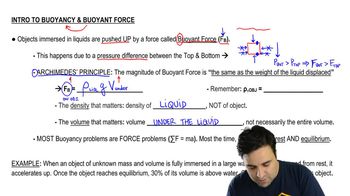
Buoyancy is the upward force exerted by a fluid that opposes the weight of an object immersed in it. This force is determined by the volume of fluid displaced by the object, which is governed by Archimedes' principle. For an object to be neutrally buoyant, the buoyant force must equal the object's weight, allowing it to neither sink nor float.
추천 영상:
가이드 코스
11:06
Intro to Buoyancy & Buoyant Force

Density

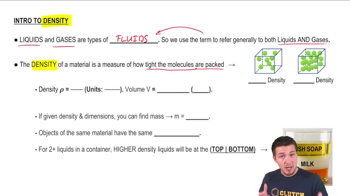
Density is defined as mass per unit volume, typically expressed in kilograms per cubic meter (kg/m³). It is a crucial factor in determining whether an object will float or sink in a fluid. In this scenario, the fish's density must be adjusted to match the density of fresh water (approximately 1000 kg/m³) to achieve neutral buoyancy.
추천 영상:
가이드 코스
8:13
Intro to Density

Volume Increase for Neutral Buoyancy

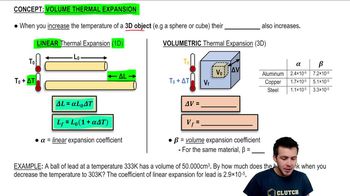
To achieve neutral buoyancy, a fish must increase its volume so that its overall density matches that of the surrounding water. This involves inflating the swim bladder with air, which has a much lower density than water. The percentage increase in volume can be calculated by determining the required volume that results in a density equal to that of the water, considering the fish's original density.
추천 영상:
가이드 코스
05:21
Volume Thermal Expansion
관련 실천
교과서 질문

An aquarium of length L, width (front to back) W, and depth D is filled to the top with liquid of density ρ. Find an expression for the force of the liquid on the front window of the aquarium.

2275
views

교과서 질문

Glycerin is poured into an open U-shaped tube until the height in both sides is 20 cm. Ethyl alcohol is then poured into one arm until the height of the alcohol column is 20 cm. The two liquids do not mix. What is the difference in height between the top surface of the glycerin and the top surface of the alcohol?

2893
views
교과서 질문

One day when you come into physics lab you find several plastic hemispheres floating like boats in a tank of fresh water. Each lab group is challenged to determine the heaviest rock that can be placed in the bottom of a plastic boat without sinking it. You get one try. Sinking the boat gets you no points, and the maximum number of points goes to the group that can place the heaviest rock without sinking. You begin by measuring one of the hemispheres, finding that it has a mass of 21 g and a diameter of 8.0 cm. What is the mass of the heaviest rock that, in perfectly still water, won't sink the plastic boat?

1845
views
교과서 질문

It's possible to use the ideal-gas law to show that the density of the earth's atmosphere decreases exponentially with height. That is, ρ = ρ₀ exp (-z/z₀), where z is the height above sea level, ρ₀ is the density at sea level (you can use the Table 14.1 value), and z₀ is called the scale height of the atmosphere. What is the density of the air in Denver, at an elevation of 1600 m? What percent of sea-level density is this?

2378
views
교과서 질문

A nonviscous liquid of density p flows at speed v₀ through a horizontal pipe that expands smoothly from diameter d₀ to a larger diameter d₁. The pressure in the narrower section is p₀. Find an expression for the pressure p₁ in the wider section.

1867
views
교과서 질문

A nuclear power plant draws 3.0 x 10⁶ L/min of cooling water from the ocean. If the water is drawn in through two parallel, 3.0-m-diameter pipes, what is the water speed in each pipe?

1498
views