Ch 14: Fluids and Elasticity
Knight Calc - Physics for Scientists and Engineers 5th Edition
Knight Calc5th EditionPhysics for Scientists and EngineersISBN: 9780137344796당신이 사용하는 게 아니라요?교과서 변경
14장, 문제 5

The deepest point in the ocean is 11 km below sea level, deeper than Mt. Everest is tall. What is the pressure in atmospheres at this depth?

검증된 단계별 안내
1
Step 1: Understand the problem. The pressure at a depth in a fluid is determined by the hydrostatic pressure formula: \( P = P_0 + \rho g h \), where \( P_0 \) is the atmospheric pressure at the surface, \( \rho \) is the density of the fluid (in this case, seawater), \( g \) is the acceleration due to gravity, and \( h \) is the depth.
Step 2: Identify the known values. Atmospheric pressure at sea level \( P_0 \) is approximately 1 atmosphere. The density of seawater \( \rho \) is about \( 1025 \, \text{kg/m}^3 \). The acceleration due to gravity \( g \) is \( 9.8 \; \text{m/s}^2 \). The depth \( h \) is given as \( 11 \, \text{km} \), which needs to be converted to meters: \( h = 11 \times 1000 = 11000 \, \text{m} \).
Step 3: Substitute the values into the hydrostatic pressure formula. The pressure at depth \( P \) is given by \( P = P_0 + \rho g h \). Replace \( P_0 \) with \( 1 \, \text{atm} \), \( \rho \) with \( 1025 \, \text{kg/m}^3 \), \( g \) with \( 9.8 \; \text{m/s}^2 \), and \( h \) with \( 11000 \, \text{m} \).
Step 4: Convert the pressure from pascals to atmospheres. The hydrostatic pressure calculated using \( \rho g h \) will be in pascals (\( \text{Pa} \)). To convert to atmospheres, use the conversion factor: \( 1 \, \text{atm} = 101325 \, \text{Pa} \). Divide the pressure in pascals by \( 101325 \) to express the result in atmospheres.
Step 5: Add the atmospheric pressure at the surface to the converted hydrostatic pressure. The total pressure at depth is the sum of the atmospheric pressure \( P_0 \) and the pressure due to the water column. This gives the final pressure in atmospheres at the depth of \( 11 \, \text{km} \).

비슷한 문제에 대한 검증된 영상 답변:

이 영상 해법은 위 문제에 도움이 된다고 튜터들이 추천한 것입니다.
영상 길이:
3m
도움이 되었나요?

주요 개념

질문에 올바르게 답하기 위해 반드시 이해해야 하는 핵심 개념들은 다음과 같습니다.

Hydrostatic Pressure

Hydrostatic pressure is the pressure exerted by a fluid at equilibrium due to the force of gravity. It increases with depth in a fluid, calculated using the formula P = ρgh, where P is pressure, ρ is the fluid density, g is the acceleration due to gravity, and h is the depth. In the ocean, the density of seawater is approximately 1025 kg/m³, which is essential for calculating the pressure at significant depths.
추천 영상:
가이드 코스
17:04
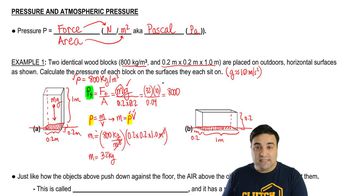
Pressure and Atmospheric Pressure

Atmospheric Pressure

Atmospheric pressure is the pressure exerted by the weight of the atmosphere above a given point. At sea level, this pressure is defined as 1 atmosphere (atm), equivalent to 101,325 pascals. When calculating pressure at depth, it is common to express the result in atmospheres, where the pressure increases by about 1 atm for every 10 meters of seawater depth.
추천 영상:
가이드 코스
17:04
Pressure and Atmospheric Pressure

Depth and Pressure Relationship

The relationship between depth and pressure in a fluid is linear, meaning that as depth increases, pressure increases proportionally. In the ocean, for every 10 meters of depth, the pressure increases by approximately 1 atm. Therefore, to find the total pressure at a specific depth, one must account for both the atmospheric pressure at the surface and the additional pressure due to the water column above.
추천 영상:
가이드 코스
17:04
Pressure and Atmospheric Pressure