A 6.0 m ✕ 12.0 m swimming pool slopes linearly from a 1.0 m depth at one end to a 3.0 m depth at the other. What is the mass of water in the pool?
Ch 14: Fluids and Elasticity
14장, 문제 6
A 1.0-m-diameter vat of liquid is 2.0 m deep. The pressure at the bottom of the vat is 1.3 atm. What is the mass of the liquid in the vat?
검증된 단계별 안내1
Step 1: Understand the relationship between pressure, depth, and density. The pressure at the bottom of the vat is due to the weight of the liquid above it. The formula for pressure at a depth in a liquid is given by: , where is the total pressure, is atmospheric pressure, is the density of the liquid, is the acceleration due to gravity, and is the depth of the liquid.
Step 2: Rearrange the formula to solve for the density of the liquid. Subtract atmospheric pressure from the total pressure to isolate the term related to the liquid: . Use the given values: atm, atm, m/s², and m.
Step 3: Calculate the volume of the liquid in the vat. The vat is cylindrical, so the volume can be calculated using the formula for the volume of a cylinder: , where is the radius of the vat and is the depth. The diameter is given as 1.0 m, so the radius is m. Substitute m and m into the formula.
Step 4: Use the density and volume to calculate the mass of the liquid. The formula for mass is , where is the density and is the volume. Substitute the values of and obtained from the previous steps.
Step 5: Ensure unit consistency throughout the calculations. Convert pressure from atm to Pascals (1 atm = 101325 Pa) and verify that all units are in SI (meters, kilograms, seconds). Perform the calculations step by step to find the mass of the liquid in the vat.

비슷한 문제에 대한 검증된 영상 답변:
이 영상 해법은 위 문제에 도움이 된다고 튜터들이 추천한 것입니다.
영상 길이:
6m주요 개념
질문에 올바르게 답하기 위해 반드시 이해해야 하는 핵심 개념들은 다음과 같습니다.
Hydrostatic Pressure
Hydrostatic pressure is the pressure exerted by a fluid at equilibrium due to the force of gravity. It increases with depth in a fluid and is calculated using the formula P = ρgh, where P is the pressure, ρ is the fluid density, g is the acceleration due to gravity, and h is the height of the fluid column.
추천 영상:
가이드 코스
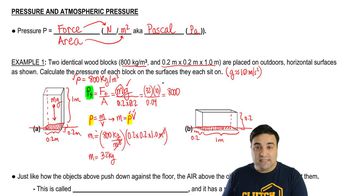
Pressure and Atmospheric Pressure
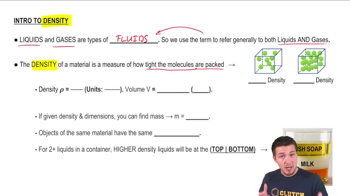
Density
Density is a measure of mass per unit volume of a substance, typically expressed in kilograms per cubic meter (kg/m³). In the context of liquids, knowing the density allows us to relate mass and volume, as mass can be calculated using the formula m = ρV, where m is mass, ρ is density, and V is volume.
추천 영상:
가이드 코스
Intro to Density
Volume of a Cylinder
The volume of a cylinder can be calculated using the formula V = πr²h, where r is the radius and h is the height. In this case, the vat is cylindrical, and knowing its diameter allows us to find the radius, which is essential for determining the total volume of liquid in the vat and subsequently its mass.
추천 영상:
가이드 코스
Volume Thermal Expansion
관련 실천
교과서 질문
1675
views
교과서 질문
The deepest point in the ocean is 11 km below sea level, deeper than Mt. Everest is tall. What is the pressure in atmospheres at this depth?
2026
views
교과서 질문
What volume of water has the same mass as 8.0 m³ of ethyl alcohol?
1721
views
교과서 질문
50 cm³ of gasoline are mixed with 50 cm³ of water. What is the average density of the mixture?
1850
views
교과서 질문
The container shown in FIGURE EX14.11 is filled with oil. It is open to the atmosphere on the left. What is the pressure difference between points 1 and 2? Between points 1 and 3?
2534
views
교과서 질문
The container shown in FIGURE EX14.11 is filled with oil. It is open to the atmosphere on the left. What is the pressure at point 1?
2102
views
1
comments