Ch 15: Oscillations
Knight Calc - Physics for Scientists and Engineers 5th Edition
Knight Calc5th EditionPhysics for Scientists and EngineersISBN: 9780137344796당신이 사용하는 게 아니라요?교과서 변경
15장, 문제 22

A spring is hung from the ceiling. When a block is attached to its end, it stretches 2.0 cm before reaching its new equilibrium length. The block is then pulled down slightly and released. What is the frequency of oscillation?

검증된 단계별 안내
1
Step 1: Identify the key variables in the problem. The spring stretches by 2.0 cm (0.02 m) under the weight of the block, which indicates the equilibrium position. The frequency of oscillation depends on the spring constant (k) and the mass of the block (m). Use Hooke's Law, which states that F = kx, where F is the force due to gravity (mg), x is the displacement (0.02 m), and k is the spring constant.
Step 2: Calculate the spring constant (k). Using Hooke's Law, rearrange the formula to solve for k: k = F/x = (mg)/x. Substitute the values for the gravitational force (mg) and the displacement (x). Note that the mass of the block (m) is not explicitly given, so it will remain as a variable in the equation.
Step 3: Recall the formula for the frequency of oscillation of a mass-spring system: f = (1/(2π)) * √(k/m). Substitute the expression for k obtained in Step 2 into this formula. This will give you the frequency in terms of the mass (m) and the displacement (x).
Step 4: Simplify the expression for frequency. Combine the constants and variables to express the frequency in terms of the given displacement (x = 0.02 m) and the acceleration due to gravity (g = 9.8 m/s²). The formula will now be f = (1/(2π)) * √(g/x).
Step 5: Substitute the numerical values for g and x into the simplified formula to calculate the frequency. Ensure that the units are consistent (meters for displacement and m/s² for gravity). The final frequency value can be determined by performing the calculation, but this step provides the framework for solving the problem.

비슷한 문제에 대한 검증된 영상 답변:

이 영상 해법은 위 문제에 도움이 된다고 튜터들이 추천한 것입니다.
영상 길이:
8m
도움이 되었나요?

주요 개념

질문에 올바르게 답하기 위해 반드시 이해해야 하는 핵심 개념들은 다음과 같습니다.

Hooke's Law

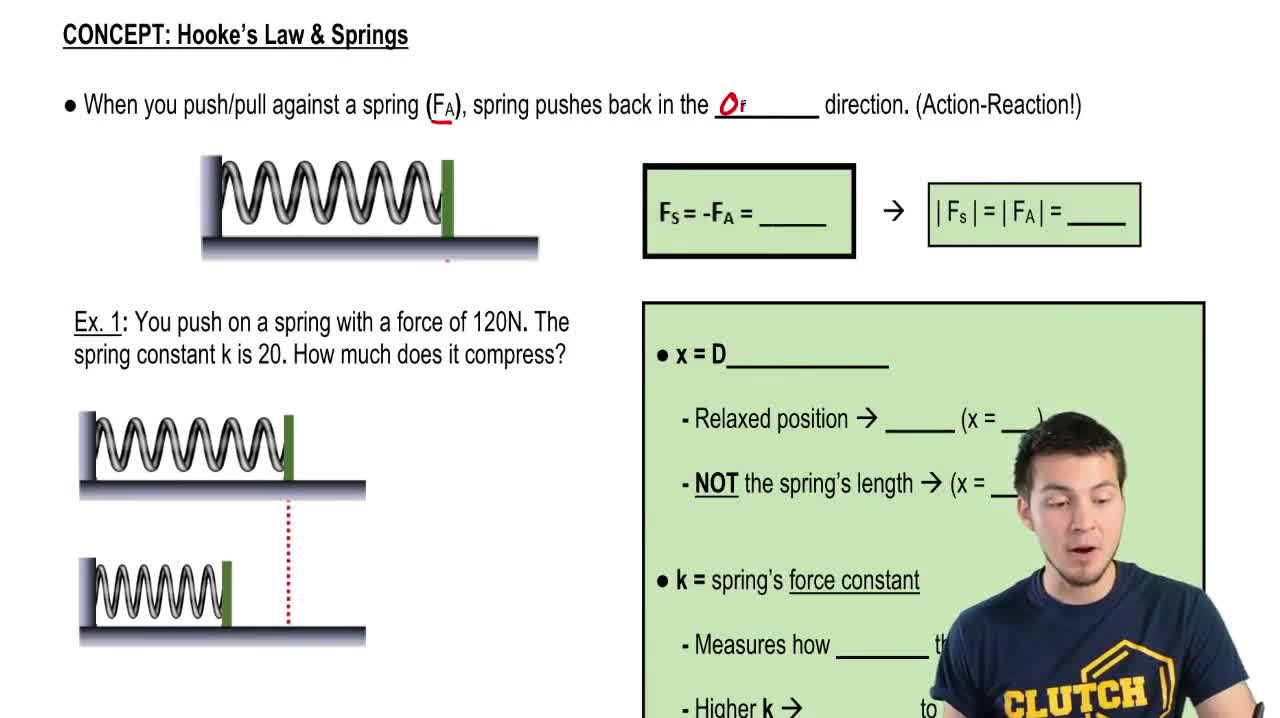
Hooke's Law states that the force exerted by a spring is directly proportional to its extension or compression, provided the elastic limit is not exceeded. Mathematically, it is expressed as F = -kx, where F is the force, k is the spring constant, and x is the displacement from the equilibrium position. This principle is fundamental in understanding how springs behave when forces are applied.
추천 영상:
가이드 코스
05:27
Spring Force (Hooke's Law)

Simple Harmonic Motion (SHM)

Simple Harmonic Motion is a type of periodic motion where an object oscillates around an equilibrium position. The motion is characterized by a restoring force that is proportional to the displacement from equilibrium, leading to a sinusoidal time dependence. In the context of the spring-block system, the block will undergo SHM after being displaced and released.
추천 영상:
가이드 코스
07:52
Simple Harmonic Motion of Pendulums

Frequency of Oscillation

The frequency of oscillation refers to the number of complete cycles of motion that occur in a unit of time, typically measured in hertz (Hz). For a mass-spring system undergoing SHM, the frequency can be calculated using the formula f = (1/2π)√(k/m), where k is the spring constant and m is the mass of the block. This relationship highlights how the mass and spring constant influence the oscillation frequency.
추천 영상:
가이드 코스
05:08
Circumference, Period, and Frequency in UCM