Ch 15: Oscillations
Knight Calc - Physics for Scientists and Engineers 5th Edition
Knight Calc5th EditionPhysics for Scientists and EngineersISBN: 9780137344796당신이 사용하는 게 아니라요?교과서 변경
15장, 문제 21b

A spring is hanging from the ceiling. Attaching a 500 g physics book to the spring causes it to stretch 20 cm in order to come to equilibrium. From equilibrium, the book is pulled down 10 cm and released. What is the period of oscillation?

검증된 단계별 안내
1
Determine the spring constant (k) using Hooke's Law: \( F = kx \). Here, \( F \) is the force exerted by the book's weight, \( F = mg \), where \( m = 0.5 \; \text{kg} \) and \( g = 9.8 \; \text{m/s}^2 \). The displacement \( x \) is 20 cm (converted to meters: \( x = 0.2 \; \text{m} \)). Rearrange Hooke's Law to solve for \( k \): \( k = \frac{F}{x} \).
Recall the formula for the period of oscillation of a mass-spring system: \( T = 2\pi \sqrt{\frac{m}{k}} \). Here, \( m \) is the mass of the book (0.5 kg), and \( k \) is the spring constant calculated in the previous step.
Substitute the value of \( m \) and the calculated \( k \) into the formula \( T = 2\pi \sqrt{\frac{m}{k}} \). Ensure that all units are consistent (mass in kilograms, spring constant in \( \text{N/m} \)).
Simplify the expression under the square root and calculate the value of \( T \) symbolically. This will give the period of oscillation in seconds.
Note that the amplitude of the oscillation (10 cm) does not affect the period, as the period of a mass-spring system depends only on the mass and the spring constant, not the amplitude.

비슷한 문제에 대한 검증된 영상 답변:

이 영상 해법은 위 문제에 도움이 된다고 튜터들이 추천한 것입니다.
영상 길이:
7m
도움이 되었나요?

주요 개념

질문에 올바르게 답하기 위해 반드시 이해해야 하는 핵심 개념들은 다음과 같습니다.

Hooke's Law

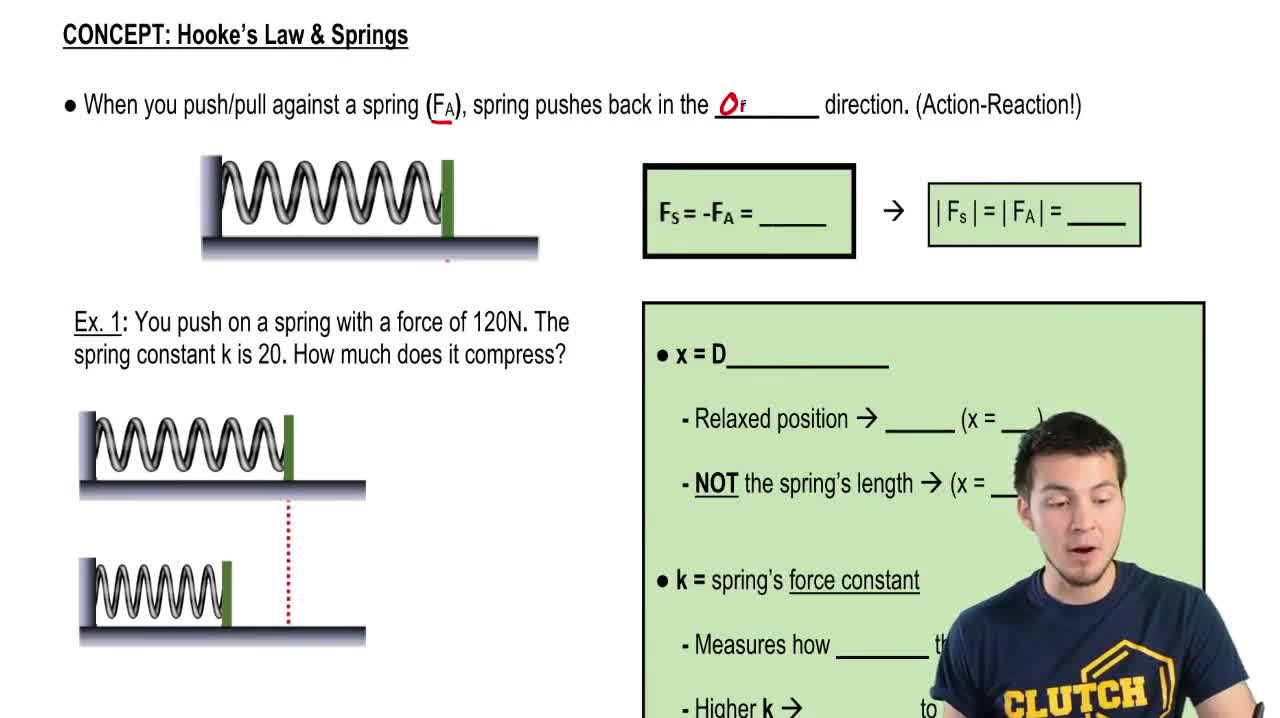
Hooke's Law states that the force exerted by a spring is directly proportional to the displacement from its equilibrium position, expressed as F = -kx, where F is the force, k is the spring constant, and x is the displacement. This principle is essential for understanding how the spring behaves when a mass is attached and how it returns to equilibrium.
추천 영상:
가이드 코스
05:27
Spring Force (Hooke's Law)

Simple Harmonic Motion (SHM)

Simple Harmonic Motion is a type of periodic motion where an object oscillates around an equilibrium position. In the case of the spring and the attached book, when the book is pulled down and released, it will oscillate back and forth about the equilibrium position, following a sinusoidal pattern characterized by a constant period and amplitude.
추천 영상:
가이드 코스
07:52
Simple Harmonic Motion of Pendulums

Period of Oscillation

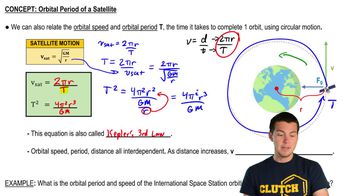
The period of oscillation is the time it takes for one complete cycle of motion in a harmonic system. For a mass-spring system, the period T can be calculated using the formula T = 2π√(m/k), where m is the mass attached to the spring and k is the spring constant. This relationship allows us to determine how long it takes for the book to complete one full oscillation after being released.
추천 영상:
가이드 코스
06:28
Satellite Period
관련 실천
교과서 질문

A pendulum is made by tying a 75 g ball to a 130-cm-long string. The ball is pulled 5.0° to the side and released. How many times does the ball pass through the lowest point of its arc in 7.5 s?

2555
views

교과서 질문

A spring is hanging from the ceiling. Attaching a 500 g physics book to the spring causes it to stretch 20 cm in order to come to equilibrium. What is the book's maximum speed?

1207
views
교과서 질문

A spring is hung from the ceiling. When a block is attached to its end, it stretches 2.0 cm before reaching its new equilibrium length. The block is then pulled down slightly and released. What is the frequency of oscillation?

1942
views
교과서 질문

A 1.0 kg block is attached to a spring with spring constant 16 N/m. While the block is sitting at rest, a student hits it with a hammer and almost instantaneously gives it a speed of 40 cm/s. What are The block's speed at the point where 𝓍 = (½)A?

1977
views
교과서 질문

A 500 g air-track glider moving at 0.50 m/s collides with a horizontal spring whose opposite end is anchored to the end of the track. Measurements show that the glider is in contact with the spring for 1.5 s before it rebounds. What is the maximum compression of the spring?

2017
views
교과서 질문

A 500 g air-track glider moving at 0.50 m/s collides with a horizontal spring whose opposite end is anchored to the end of the track. Measurements show that the glider is in contact with the spring for 1.5 s before it rebounds. What is the value of the spring constant?

1459
views