Ch 15: Oscillations
Knight Calc - Physics for Scientists and Engineers 5th Edition
Knight Calc5th EditionPhysics for Scientists and EngineersISBN: 9780137344796당신이 사용하는 게 아니라요?교과서 변경
15장, 문제 1b

An air-track glider is attached to a spring. The glider is pulled to the right and released from rest at t = 0 s. It then oscillates with a period of 2.0 s and a maximum speed of 40 cm/s. What is the glider's position at t = 0.25 s?

검증된 단계별 안내
1
Step 1: Recognize that the motion of the glider is simple harmonic motion (SHM). The position of the glider as a function of time can be expressed using the equation: x=Asin(ωt), where A is the amplitude, ω is the angular frequency, and t is the time.
Step 2: Calculate the angular frequency ω using the relationship between the period and angular frequency: ω=2π/T, where T is the period. Substitute T=2.0 seconds into the formula.
Step 3: Determine the amplitude A using the maximum speed of the glider. The maximum speed in SHM is given by v=Aω. Rearrange the formula to solve for A: A=vω. Substitute the maximum speed v=40 cm/s and the calculated value of ω into the formula.
Step 4: Substitute the values of A, ω, and t=0.25 seconds into the position equation x=Asin(ωt).
Step 5: Evaluate the sine function to find the position of the glider at t=0.25 seconds. Ensure the units are consistent throughout the calculation (e.g., converting cm to m if necessary).

비슷한 문제에 대한 검증된 영상 답변:

이 영상 해법은 위 문제에 도움이 된다고 튜터들이 추천한 것입니다.
영상 길이:
4m
도움이 되었나요?

주요 개념

질문에 올바르게 답하기 위해 반드시 이해해야 하는 핵심 개념들은 다음과 같습니다.

Simple Harmonic Motion (SHM)

Simple Harmonic Motion is a type of periodic motion where an object oscillates around an equilibrium position. In SHM, the restoring force is directly proportional to the displacement from the equilibrium and acts in the opposite direction. The motion can be described by sine or cosine functions, which represent the position, velocity, and acceleration of the object over time.
추천 영상:
가이드 코스
07:52
Simple Harmonic Motion of Pendulums

Period and Frequency

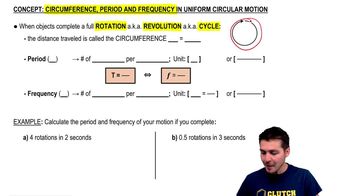
The period of an oscillating system is the time it takes to complete one full cycle of motion, while frequency is the number of cycles per unit time. They are inversely related; the period (T) is the reciprocal of frequency (f), expressed as T = 1/f. In this case, a period of 2.0 s indicates that the glider completes one full oscillation every 2 seconds.
추천 영상:
가이드 코스
05:08
Circumference, Period, and Frequency in UCM

Maximum Speed in SHM

In Simple Harmonic Motion, the maximum speed of an oscillating object occurs as it passes through the equilibrium position. This speed can be calculated using the formula v_max = Aω, where A is the amplitude and ω is the angular frequency (ω = 2π/T). The maximum speed provides insight into the energy and dynamics of the oscillating system.
추천 영상:
가이드 코스
07:59
Speed Distribution & Special Speeds of Ideal Gases