

Ch 15: Oscillations
Knight Calc - Physics for Scientists and Engineers 5th Edition
Knight Calc5th EditionPhysics for Scientists and EngineersISBN: 9780137344796당신이 사용하는 게 아니라요?교과서 변경
15장, 문제 3

An object in SHM oscillates with a period of 4.0 s and an amplitude of 10 cm. How long does the object take to move from x = 0.0 cm to x = 6.0 cm?

검증된 단계별 안내
1
Step 1: Recall the equation for the position of an object in simple harmonic motion (SHM): x=Asin(ωt), where x is the position, A is the amplitude, ω is the angular frequency, and t is the time.
Step 2: Calculate the angular frequency ω using the relationship ω=2π/T, where T is the period. Substitute T=4.0 s into the equation.
Step 3: Rearrange the SHM equation to solve for time t: t=sin-1(xA)ω. Substitute x=6.0 cm and A=10 cm into the equation.
Step 4: Simplify the argument of the sine inverse function: xA=6.010=0.6. Then calculate sin-1(0.6).
Step 5: Divide the result of sin-1(0.6) by the angular frequency ω to find the time t. This gives the time it takes for the object to move from x=0.0 cm to x=6.0 cm.

비슷한 문제에 대한 검증된 영상 답변:

이 영상 해법은 위 문제에 도움이 된다고 튜터들이 추천한 것입니다.
영상 길이:
5m

주요 개념

질문에 올바르게 답하기 위해 반드시 이해해야 하는 핵심 개념들은 다음과 같습니다.

Simple Harmonic Motion (SHM)

Simple Harmonic Motion is a type of periodic motion where an object oscillates around an equilibrium position. The motion is characterized by a restoring force proportional to the displacement from the equilibrium, leading to sinusoidal motion. Key parameters include amplitude, period, and frequency, which define the motion's characteristics.
추천 영상:
가이드 코스
07:52
Simple Harmonic Motion of Pendulums

Amplitude and Period

Amplitude is the maximum displacement of an object from its equilibrium position in SHM, while the period is the time taken to complete one full cycle of motion. In this case, the amplitude is 10 cm, indicating the maximum distance from the center, and the period of 4.0 s defines how long it takes to return to the same position in the cycle.
추천 영상:
가이드 코스
06:28
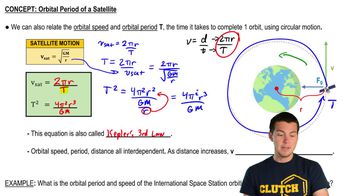
Satellite Period

Position in SHM

The position of an object in SHM can be described using the equation x(t) = A cos(ωt + φ), where A is the amplitude, ω is the angular frequency, and φ is the phase constant. To find the time taken to move from one position to another, we can calculate the corresponding angles and use the period to determine the time interval.
추천 영상:
가이드 코스
14:03
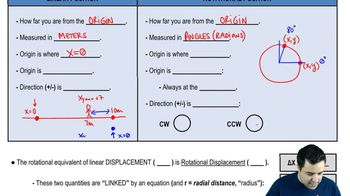
Rotational Position & Displacement