Ch 15: Oscillations
15์žฅ, ๋ฌธ์ œ 17e

The position of a 50 g oscillating mass is given by ๐“(t) = (2.0 cm) cos (10 t - ฯ€/4), where t is in s. Determine: The initial conditions.

๊ฒ€์ฆ๋œ ๋‹จ๊ณ„๋ณ„ ์•ˆ๋‚ด
1
Step 1: Understand the given equation for the position of the oscillating mass: ๐“(t) = (2.0 cm) cos(10t - ฯ€/4). Here, the amplitude is 2.0 cm, the angular frequency is 10 rad/s, and the phase constant is -ฯ€/4. The initial conditions refer to the position and velocity of the mass at t = 0.
Step 2: To find the initial position, substitute t = 0 into the position equation. This gives ๐“(0) = (2.0 cm) cos(-ฯ€/4). Use the trigonometric identity cos(-ฮธ) = cos(ฮธ) to simplify the expression.
Step 3: To find the initial velocity, differentiate the position equation with respect to time to get the velocity equation. The derivative of ๐“(t) = (2.0 cm) cos(10t - ฯ€/4) is v(t) = -Aฯ‰ sin(ฯ‰t - ฯ†), where A is the amplitude, ฯ‰ is the angular frequency, and ฯ† is the phase constant. Substituting the given values, v(t) = -(2.0 cm)(10 rad/s) sin(10t - ฯ€/4).
Step 4: Substitute t = 0 into the velocity equation to find the initial velocity. This gives v(0) = -(2.0 cm)(10 rad/s) sin(-ฯ€/4). Use the trigonometric identity sin(-ฮธ) = -sin(ฮธ) to simplify the expression.
Step 5: Combine the results from Step 2 and Step 4 to summarize the initial conditions: the initial position ๐“(0) and the initial velocity v(0). These values describe the state of the oscillating mass at t = 0.

๋น„์Šทํ•œ ๋ฌธ์ œ์— ๋Œ€ํ•œ ๊ฒ€์ฆ๋œ ์˜์ƒ ๋‹ต๋ณ€:

์ด ์˜์ƒ ํ•ด๋ฒ•์€ ์œ„ ๋ฌธ์ œ์— ๋„์›€์ด ๋œ๋‹ค๊ณ  ํŠœํ„ฐ๋“ค์ด ์ถ”์ฒœํ•œ ๊ฒƒ์ž…๋‹ˆ๋‹ค.
์˜์ƒ ๊ธธ์ด:
3m

์ฃผ์š” ๊ฐœ๋…

์งˆ๋ฌธ์— ์˜ฌ๋ฐ”๋ฅด๊ฒŒ ๋‹ตํ•˜๊ธฐ ์œ„ํ•ด ๋ฐ˜๋“œ์‹œ ์ดํ•ดํ•ด์•ผ ํ•˜๋Š” ํ•ต์‹ฌ ๊ฐœ๋…๋“ค์€ ๋‹ค์Œ๊ณผ ๊ฐ™์Šต๋‹ˆ๋‹ค.

Oscillation

Oscillation refers to the repetitive variation, typically in time, of some measure about a central value or between two or more different states. In this context, it describes the motion of the mass as it moves back and forth around an equilibrium position, characterized by parameters such as amplitude, frequency, and phase.
์ถ”์ฒœ ์˜์ƒ:

Initial Conditions

Initial conditions are the values of the variables at the start of the observation or experiment, which in this case refers to the position and velocity of the oscillating mass at time t = 0. These conditions are crucial for determining the future behavior of the system and are derived from the given position function.
์ถ”์ฒœ ์˜์ƒ:

Phase Angle

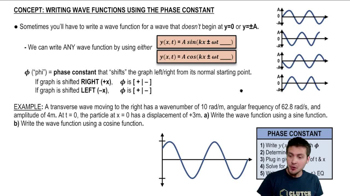
The phase angle in oscillatory motion indicates the initial position of the oscillating object relative to a reference point. In the equation provided, the phase angle of -ฯ€/4 affects the starting position of the mass, shifting the cosine function and thus altering the initial conditions of the oscillation.
์ถ”์ฒœ ์˜์ƒ:
๊ฐ€์ด๋“œ ์ฝ”์Šค
08:59
Phase Constant of a Wave Function
๊ด€๋ จ ์‹ค์ฒœ
๊ต๊ณผ์„œ ์งˆ๋ฌธ

The position of a 50 g oscillating mass is given by ๐“(t) = (2.0 cm) cos (10 t - ฯ€/4), where t is in s. Determine: The velocity at t = 0.40 s.

1696
views

๊ต๊ณผ์„œ ์งˆ๋ฌธ

A 200 g mass attached to a horizontal spring oscillates at a frequency of 2.0 Hz. At t = 0 s, the mass is at x = 5.0 cm and has vx = -30 cm/s. Determine: The maximum speed.

3220
views
๊ต๊ณผ์„œ ์งˆ๋ฌธ

A 200 g mass attached to a horizontal spring oscillates at a frequency of 2.0 Hz. At t = 0 s, the mass is at x = 5.0 cm and has vx = -30 cm/s. Determine: The position at t = 0.40 s.

1410
views
๊ต๊ณผ์„œ ์งˆ๋ฌธ

A 1.0 kg block is attached to a spring with spring constant 16 N/m. While the block is sitting at rest, a student hits it with a hammer and almost instantaneously gives it a speed of 40 cm/s. What are The block's speed at the point where ๐“ = (ยฝ)A?

1977
views
๊ต๊ณผ์„œ ์งˆ๋ฌธ

A 200 g mass attached to a horizontal spring oscillates at a frequency of 2.0 Hz. At t = 0 s, the mass is at x = 5.0 cm and has vโ‚“ = -30 cm/s. Determine: The total energy.

1219
views
๊ต๊ณผ์„œ ์งˆ๋ฌธ

A 500 g air-track glider moving at 0.50 m/s collides with a horizontal spring whose opposite end is anchored to the end of the track. Measurements show that the glider is in contact with the spring for 1.5 s before it rebounds. What is the value of the spring constant?

1459
views