Ch 15: Oscillations
Knight Calc - Physics for Scientists and Engineers 5th Edition
Knight Calc5th EditionPhysics for Scientists and EngineersISBN: 9780137344796당신이 사용하는 게 아니라요?교과서 변경
15장, 문제 19a

A 500 g air-track glider moving at 0.50 m/s collides with a horizontal spring whose opposite end is anchored to the end of the track. Measurements show that the glider is in contact with the spring for 1.5 s before it rebounds. What is the value of the spring constant?

검증된 단계별 안내
1
Convert the mass of the glider from grams to kilograms: \( m = 500 \ \text{g} = 0.500 \ \text{kg} \). This ensures consistency in SI units.
Determine the initial kinetic energy of the glider using the formula for kinetic energy: \( KE = \frac{1}{2} m v^2 \), where \( v = 0.50 \ \text{m/s} \) is the initial velocity of the glider.
Recognize that the glider compresses the spring until it comes to a stop, at which point all the kinetic energy is converted into elastic potential energy stored in the spring. The elastic potential energy is given by \( PE = \frac{1}{2} k x^2 \), where \( k \) is the spring constant and \( x \) is the maximum compression of the spring.
Use the fact that the glider is in contact with the spring for \( t = 1.5 \ \text{s} \). Assuming simple harmonic motion, the time for one full oscillation is related to the spring constant and mass by \( T = 2\pi \sqrt{\frac{m}{k}} \). Since the glider only compresses the spring and rebounds, the time in contact corresponds to half an oscillation: \( t = \frac{T}{2} \). Substitute \( T = 2t \) into the formula for \( T \).
Rearrange the equation \( T = 2\pi \sqrt{\frac{m}{k}} \) to solve for the spring constant \( k \): \( k = \frac{4\pi^2 m}{T^2} \). Substitute \( T = 2t \) and the known values of \( m \) and \( t \) to calculate \( k \).

비슷한 문제에 대한 검증된 영상 답변:

이 영상 해법은 위 문제에 도움이 된다고 튜터들이 추천한 것입니다.
영상 길이:
2m
도움이 되었나요?

주요 개념

질문에 올바르게 답하기 위해 반드시 이해해야 하는 핵심 개념들은 다음과 같습니다.

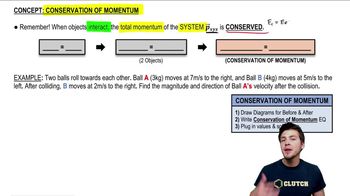
Conservation of Momentum

The principle of conservation of momentum states that in a closed system, the total momentum before an event must equal the total momentum after the event, provided no external forces act on it. In this scenario, the glider's momentum before colliding with the spring will be transferred to the spring during the collision, allowing us to analyze the interaction and determine the spring constant.
추천 영상:
가이드 코스
05:58
Conservation Of Momentum

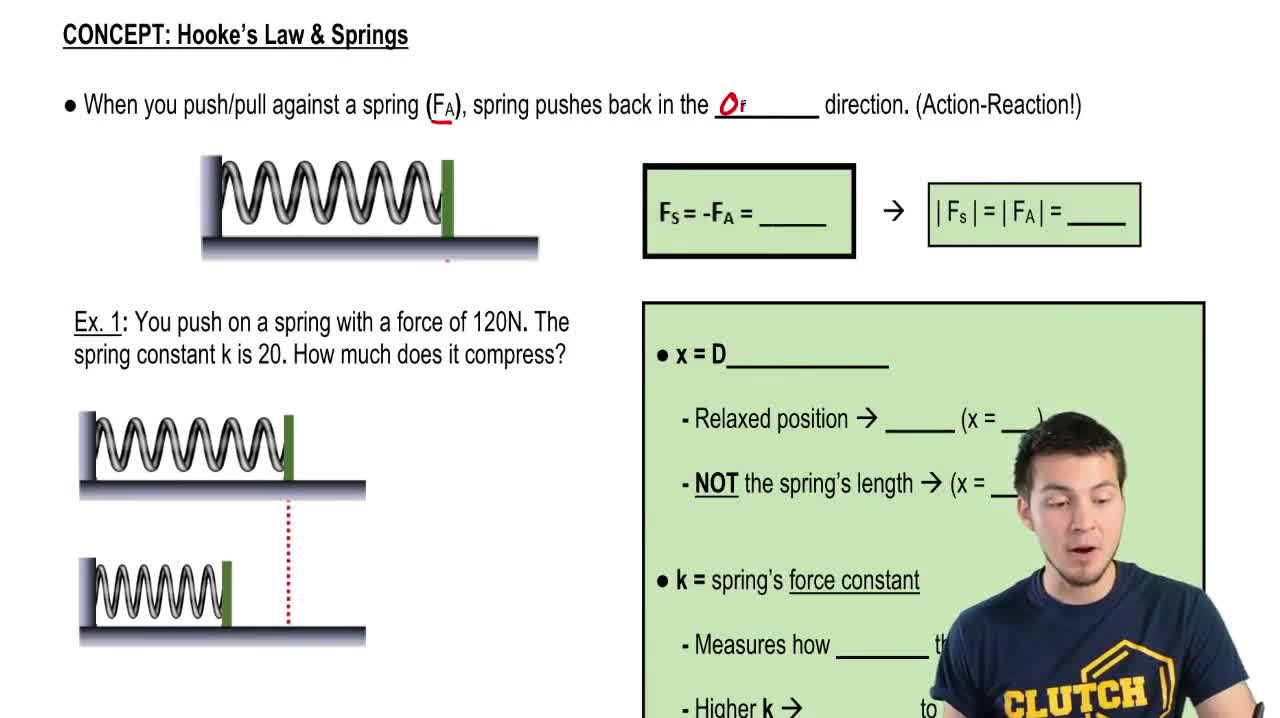
Hooke's Law

Hooke's Law describes the relationship between the force exerted by a spring and its displacement from the equilibrium position. It states that the force exerted by a spring is directly proportional to the displacement, expressed as F = -kx, where F is the force, k is the spring constant, and x is the displacement. This law is essential for calculating the spring constant in the context of the glider's collision with the spring.
추천 영상:
가이드 코스
05:27
Spring Force (Hooke's Law)

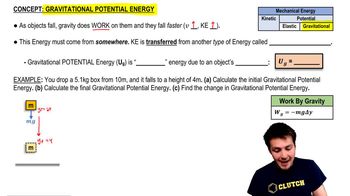
Kinetic Energy and Potential Energy

Kinetic energy is the energy of an object due to its motion, calculated as KE = 0.5mv², where m is mass and v is velocity. Potential energy stored in a spring is given by PE = 0.5kx². During the collision, the kinetic energy of the glider is converted into potential energy in the spring, allowing us to relate the two forms of energy to find the spring constant after determining the maximum compression of the spring.
추천 영상:
가이드 코스
06:35
Gravitational Potential Energy