Ch 16: Traveling Waves
Knight Calc - Physics for Scientists and Engineers 5th Edition
Knight Calc5th EditionPhysics for Scientists and EngineersISBN: 9780137344796당신이 사용하는 게 아니라요?교과서 변경
16장, 문제 23

A 15-cm-long aluminum tank is filled with ethyl alcohol. A high-frequency ultrasound wave travels horizontally through one wall of the tank and then through the alcohol. There are 275 times more cycles of the wave in the alcohol than in the aluminum wall. How thick is the wall of the tank?

검증된 단계별 안내
1
Identify the relationship between the number of cycles, the speed of sound, and the thickness of the materials. The number of cycles is proportional to the time the wave spends traveling through each material, which depends on the thickness and the speed of sound in that material.
Let the thickness of the aluminum wall be \( d \). The time taken for the wave to travel through the aluminum wall is \( t_{\text{Al}} = \frac{d}{v_{\text{Al}}} \), where \( v_{\text{Al}} \) is the speed of sound in aluminum.
The time taken for the wave to travel through the ethyl alcohol is \( t_{\text{alcohol}} = \frac{L}{v_{\text{alcohol}}} \), where \( L = 15 \, \text{cm} \) is the length of the alcohol tank and \( v_{\text{alcohol}} \) is the speed of sound in ethyl alcohol.
The problem states that there are 275 times more cycles in the alcohol than in the aluminum. This means the ratio of the times is \( \frac{t_{\text{alcohol}}}{t_{\text{Al}}} = 275 \). Substitute the expressions for \( t_{\text{alcohol}} \) and \( t_{\text{Al}} \) into this equation: \( \frac{\frac{L}{v_{\text{alcohol}}}}{\frac{d}{v_{\text{Al}}}} = 275 \).
Solve for \( d \) (the thickness of the aluminum wall): \( d = \frac{L \cdot v_{\text{Al}}}{275 \cdot v_{\text{alcohol}}} \). Substitute the known values for \( L \), \( v_{\text{Al}} \), and \( v_{\text{alcohol}} \) to find the thickness of the wall.

비슷한 문제에 대한 검증된 영상 답변:

이 영상 해법은 위 문제에 도움이 된다고 튜터들이 추천한 것입니다.

주요 개념

질문에 올바르게 답하기 위해 반드시 이해해야 하는 핵심 개념들은 다음과 같습니다.

Ultrasound Waves

Ultrasound waves are sound waves with frequencies higher than the upper limit of human hearing, typically above 20 kHz. These waves can travel through different media, such as solids, liquids, and gases, and their speed and behavior depend on the medium's properties. In this scenario, the ultrasound wave's interaction with the aluminum wall and ethyl alcohol is crucial for understanding how it propagates and the relationship between frequency and wavelength.
추천 영상:
가이드 코스
07:19
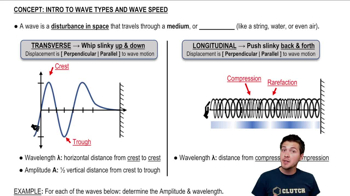
Intro to Waves and Wave Speed

Wave Frequency and Cycles

Frequency refers to the number of cycles of a wave that pass a point in one second, measured in hertz (Hz). In this problem, the fact that there are 275 times more cycles in the alcohol than in the aluminum indicates a relationship between the wave's frequency in different media. This concept is essential for determining how the wave's speed and wavelength change as it moves from one medium to another.
추천 영상:

Speed of Sound in Different Media

The speed of sound varies in different materials due to differences in density and elasticity. In general, sound travels faster in solids than in liquids and gases. Understanding the speed of sound in both aluminum and ethyl alcohol is vital for solving the problem, as it allows us to relate the thickness of the wall to the frequency and wavelength of the ultrasound wave as it transitions between the two media.
추천 영상:
가이드 코스
05:17
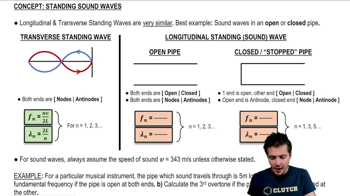
Standing Sound Waves