Ch 16: Traveling Waves
Knight Calc - Physics for Scientists and Engineers 5th Edition
Knight Calc5th EditionPhysics for Scientists and EngineersISBN: 9780137344796당신이 사용하는 게 아니라요?교과서 변경
16장, 문제 31a

A sound source is located somewhere along the x-axis. Experiments show that the same wave front simultaneously reaches listeners at x = -7.0 m and x = +3.0 m. What is the x-coordinate of the source?

검증된 단계별 안내
1
The problem involves determining the x-coordinate of the sound source based on the symmetry of the wave front. A wave front propagates outward in all directions from the source, so the source must be equidistant from the two given points.
Let the x-coordinate of the source be denoted as \( x_s \). The two listeners are located at \( x_1 = -7.0 \ \text{m} \) and \( x_2 = +3.0 \ \text{m} \). The source must lie at the midpoint between these two points.
The formula for the midpoint between two points \( x_1 \) and \( x_2 \) is given by: \( x_s = \frac{x_1 + x_2}{2} \).
Substitute the values \( x_1 = -7.0 \ \text{m} \) and \( x_2 = +3.0 \ \text{m} \) into the formula: \( x_s = \frac{-7.0 + 3.0}{2} \).
Simplify the expression to find the x-coordinate of the source. This will give the location of the sound source along the x-axis.

비슷한 문제에 대한 검증된 영상 답변:

이 영상 해법은 위 문제에 도움이 된다고 튜터들이 추천한 것입니다.
영상 길이:
3m
도움이 되었나요?

주요 개념

질문에 올바르게 답하기 위해 반드시 이해해야 하는 핵심 개념들은 다음과 같습니다.

Wave Fronts

A wave front is an imaginary surface representing points of a wave that oscillate in phase. In the context of sound waves, it indicates the position of the wave at a given moment in time. When a wave front reaches multiple observers simultaneously, it suggests that they are equidistant from the source, allowing for the determination of the source's location.
추천 영상:
가이드 코스
07:19
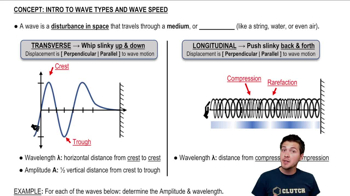
Intro to Waves and Wave Speed

Sound Propagation

Sound propagates as a longitudinal wave through a medium, such as air, where particles oscillate parallel to the direction of wave travel. The speed of sound in air is approximately 343 m/s at room temperature. Understanding how sound travels helps in analyzing the distances from the source to the listeners based on the time it takes for the sound to reach them.
추천 영상:
가이드 코스
05:17
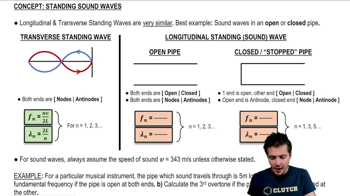
Standing Sound Waves

Equidistant Points

Equidistant points are locations that are the same distance from a reference point, in this case, the sound source. If two listeners receive the sound wave simultaneously, the source must lie on the perpendicular bisector of the line segment connecting the two listeners. This geometric principle is crucial for calculating the position of the sound source along the x-axis.
추천 영상:
가이드 코스
08:35
Angular Momentum of a Point Mass
관련 실천
교과서 질문

A loudspeaker at the origin emits a 120 Hz tone on a day when the speed of sound is 340 m/s. The phase difference between two points on the x-axis is 5.5 rad. What is the distance between these two points?

439
views

교과서 질문

What is the speed of sound in air (a) on a cold winter day in Minnesota when the temperature is -25°F, and (b) on a hot summer day in Death Valley when the temperature is 125°F?

1277
views
교과서 질문

A sound wave with intensity 2.0 x 10⁻³ W/m2 is perceived to be modestly loud. Your eardrum is 6.0 mm in diameter. How much energy will be transferred to your eardrum while listening to this sound for 1.0 min?

1484
views
교과서 질문

The intensity of electromagnetic waves from the sun is 1.4 kW/m² just above the earth's atmosphere. Eighty percent of this reaches the surface at noon on a clear summer day. Suppose you think of your back as a 30 cm x 50 cm rectangle. How many joules of solar energy fall on your back as you work on your tan for 1.0 h?

1133
views
교과서 질문

A 15-cm-long aluminum tank is filled with ethyl alcohol. A high-frequency ultrasound wave travels horizontally through one wall of the tank and then through the alcohol. There are 275 times more cycles of the wave in the alcohol than in the aluminum wall. How thick is the wall of the tank?

190
views
교과서 질문

A spherical wave with a wavelength of 2.0 m is emitted from the origin. At one instant of time, the phase at r = 4.0 m is π rad. At that instant, what is the phase at r = 3.5 m and at r = 4.5 m?

380
views