Ch 18: A Macroscopic Description of Matter
Knight Calc - Physics for Scientists and Engineers 5th Edition
Knight Calc5th EditionPhysics for Scientists and EngineersISBN: 9780137344796당신이 사용하는 게 아니라요?교과서 변경
18장, 문제 32a

0.10 mol of argon gas is admitted to an evacuated 50 cm3 container at 20°C. The gas then undergoes an isochoric heating to a temperature of 300°C. What is the final pressure of the gas?

검증된 단계별 안내
1
Step 1: Start by identifying the given values and converting them into appropriate SI units. The initial number of moles of argon gas is \( n = 0.10 \; \text{mol} \). The volume of the container is \( V = 50 \; \text{cm}^3 = 50 \times 10^{-6} \; \text{m}^3 \). The initial temperature is \( T_1 = 20^\circ \text{C} = 20 + 273.15 = 293.15 \; \text{K} \), and the final temperature is \( T_2 = 300^\circ \text{C} = 300 + 273.15 = 573.15 \; \text{K} \).
Step 2: Use the ideal gas law to find the initial pressure of the gas. The ideal gas law is \( PV = nRT \), where \( P \) is the pressure, \( V \) is the volume, \( n \) is the number of moles, \( R \) is the universal gas constant \( R = 8.314 \; \text{J/(mol·K)} \), and \( T \) is the temperature. Rearrange the equation to solve for \( P_1 \): \( P_1 = \frac{nRT_1}{V} \). Substitute the known values to calculate \( P_1 \).
Step 3: Recognize that the process is isochoric, meaning the volume remains constant. For an isochoric process, the pressure and temperature are related by the equation \( \frac{P_1}{T_1} = \frac{P_2}{T_2} \). Rearrange this equation to solve for the final pressure \( P_2 \): \( P_2 = P_1 \cdot \frac{T_2}{T_1} \).
Step 4: Substitute the value of \( P_1 \) from Step 2 and the temperatures \( T_1 \) and \( T_2 \) into the equation from Step 3 to calculate \( P_2 \). Ensure that all units are consistent (e.g., temperature in Kelvin).
Step 5: The final pressure \( P_2 \) is the result of the calculation in Step 4. Express the answer in Pascals (Pa) or another appropriate unit of pressure, depending on the context of the problem.

비슷한 문제에 대한 검증된 영상 답변:

이 영상 해법은 위 문제에 도움이 된다고 튜터들이 추천한 것입니다.
영상 길이:
5m
도움이 되었나요?

주요 개념

질문에 올바르게 답하기 위해 반드시 이해해야 하는 핵심 개념들은 다음과 같습니다.

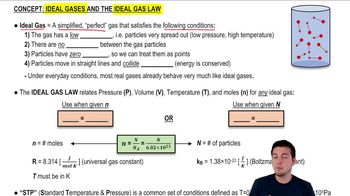
Ideal Gas Law

The Ideal Gas Law relates the pressure, volume, temperature, and number of moles of a gas through the equation PV = nRT. In this scenario, it is essential for calculating the final pressure of the argon gas after heating, as it allows us to understand how changes in temperature affect pressure when volume is constant.
추천 영상:
가이드 코스
07:21
Ideal Gases and the Ideal Gas Law

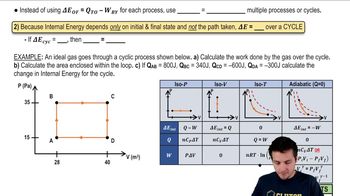
Isochoric Process

An isochoric process is one in which the volume of the gas remains constant. In this case, the argon gas is heated in a fixed volume container, meaning any increase in temperature will directly affect the pressure according to the Ideal Gas Law, without any change in volume.
추천 영상:
가이드 코스
08:45
Properties of Cyclic Thermodynamic Processes

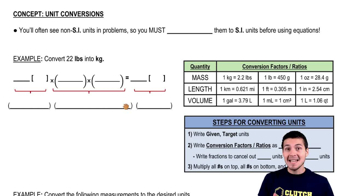
Temperature Conversion

Temperature must be expressed in Kelvin when using the Ideal Gas Law. To convert Celsius to Kelvin, add 273.15 to the Celsius temperature. This conversion is crucial for accurately calculating the final pressure after the gas is heated from 20°C to 300°C.
추천 영상:
가이드 코스
07:46
Unit Conversions