Ch 18: A Macroscopic Description of Matter
Knight Calc - Physics for Scientists and Engineers 5th Edition
Knight Calc5th EditionPhysics for Scientists and EngineersISBN: 9780137344796당신이 사용하는 게 아니라요?교과서 변경
18장, 문제 28a

A gas with initial state variables p1, V1, and T1 expands isothermally until V2 = 2V1. What are T1?

검증된 단계별 안내
1
Step 1: Recognize that the process is isothermal, meaning the temperature remains constant throughout the expansion. Therefore, T₁ = T₂.
Step 2: Recall the ideal gas law, which is expressed as PV = nRT, where P is pressure, V is volume, n is the number of moles, R is the gas constant, and T is temperature.
Step 3: Since the temperature is constant (T₁ = T₂), the product of pressure and volume remains constant during the expansion. This is expressed as p₁V₁ = p₂V₂.
Step 4: Substitute the given relationship for the final volume, V₂ = 2V₁, into the equation p₁V₁ = p₂V₂ to find the relationship between p₁ and p₂.
Step 5: Conclude that since the temperature remains constant, T₂ = T₁. No further calculation is needed for T₂.

비슷한 문제에 대한 검증된 영상 답변:

이 영상 해법은 위 문제에 도움이 된다고 튜터들이 추천한 것입니다.
영상 길이:
2m
도움이 되었나요?

주요 개념

질문에 올바르게 답하기 위해 반드시 이해해야 하는 핵심 개념들은 다음과 같습니다.

Isothermal Process

An isothermal process is a thermodynamic process in which the temperature of the system remains constant. For an ideal gas, this means that any heat added to the system is used to do work, rather than increasing the internal energy. In this scenario, since the gas expands isothermally, the temperature T₂ will equal the initial temperature T₁.
추천 영상:
가이드 코스
06:13
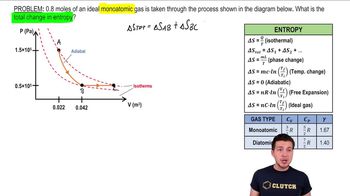
Entropy & Ideal Gas Processes

Ideal Gas Law

The Ideal Gas Law is a fundamental equation in thermodynamics that relates the pressure, volume, temperature, and number of moles of an ideal gas. It is expressed as PV = nRT, where P is pressure, V is volume, n is the number of moles, R is the ideal gas constant, and T is temperature. This law helps in understanding how changes in volume and temperature affect the state of the gas during the isothermal expansion.
추천 영상:
가이드 코스
07:21
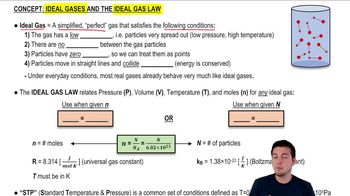
Ideal Gases and the Ideal Gas Law

Charles's Law

Charles's Law states that the volume of a gas is directly proportional to its temperature when pressure is held constant. This relationship implies that if the volume of a gas increases, its temperature must also increase, provided the pressure does not change. In the context of the isothermal expansion, while the volume doubles, the temperature remains constant, reinforcing the concept that T₂ = T₁.
추천 영상: