
Ch 18: A Macroscopic Description of Matter
Knight Calc - Physics for Scientists and Engineers 5th Edition
Knight Calc5th EditionPhysics for Scientists and EngineersISBN: 9780137344796당신이 사용하는 게 아니라요?교과서 변경
18장, 문제 72

An inflated bicycle inner tube is 2.2 cm in diameter and 200 cm in circumference. A small leak causes the gauge pressure to decrease from 110 psi to 80 psi on a day when the temperature is 20°C. What mass of air is lost? Assume the air is pure nitrogen.

검증된 단계별 안내
1
Determine the initial and final pressures in absolute terms by adding atmospheric pressure (approximately 14.7 psi) to the gauge pressures. Convert these pressures to Pascals (Pa) using the conversion factor: 1 psi = 6894.76 Pa.
Use the ideal gas law, \( PV = nRT \), to relate the initial and final states of the gas. Here, \( P \) is pressure, \( V \) is volume, \( n \) is the number of moles, \( R \) is the ideal gas constant (8.314 J/(mol·K)), and \( T \) is temperature in Kelvin. Convert the temperature from Celsius to Kelvin using \( T(K) = T(°C) + 273.15 \).
Calculate the volume of the inner tube. Treat the tube as a cylindrical shell. The volume \( V \) can be approximated as \( V = \pi r^2 h \), where \( r \) is the radius (half the diameter) and \( h \) is the circumference. Convert the dimensions to meters before calculating.
Using the ideal gas law, calculate the initial number of moles \( n_1 \) and the final number of moles \( n_2 \) of nitrogen in the inner tube. Rearrange the ideal gas law to solve for \( n \): \( n = \frac{PV}{RT} \). Use the initial and final pressures, the calculated volume, and the temperature in Kelvin.
Find the mass of air lost by calculating the difference in moles \( \Delta n = n_1 - n_2 \) and multiplying by the molar mass of nitrogen (28.02 g/mol). Convert the result to kilograms by dividing by 1000.

비슷한 문제에 대한 검증된 영상 답변:

이 영상 해법은 위 문제에 도움이 된다고 튜터들이 추천한 것입니다.
영상 길이:
8m
도움이 되었나요?

주요 개념

질문에 올바르게 답하기 위해 반드시 이해해야 하는 핵심 개념들은 다음과 같습니다.

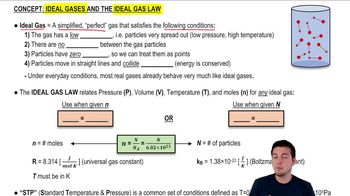
Ideal Gas Law

The Ideal Gas Law relates the pressure, volume, temperature, and number of moles of a gas through the equation PV = nRT. This law is essential for understanding how changes in pressure and temperature affect the volume and amount of gas present. In this scenario, it helps determine how the decrease in pressure due to the leak correlates with the loss of air mass.
추천 영상:
가이드 코스
07:21
Ideal Gases and the Ideal Gas Law

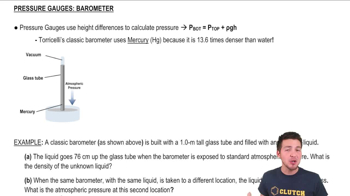
Gauge Pressure

Gauge pressure is the pressure of a system above atmospheric pressure. It is measured relative to the ambient atmospheric pressure and is crucial for understanding the pressure changes in the inner tube. In this question, the initial and final gauge pressures indicate how much air has escaped due to the leak.
추천 영상:
가이드 코스
09:27
Pressure Gauges: Barometer

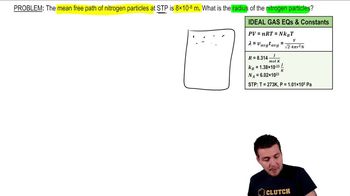
Density of Nitrogen

The density of nitrogen at standard conditions is approximately 1.25 kg/m³. Knowing the density is vital for calculating the mass of the air lost when the pressure changes. By using the Ideal Gas Law and the change in volume due to the pressure drop, one can find the volume of nitrogen lost and subsequently its mass.
추천 영상:
가이드 코스
06:18
Calculating Radius of Nitrogen
관련 실천
교과서 질문

The closed cylinder of FIGURE CP18.74 has a tight-fitting but frictionless piston of mass M. The piston is in equilibrium when the left chamber has pressure p₀ and length L₀ while the spring on the right is compressed by ΔL. Suppose the piston is moved a small distance x to the right. Find an expression for the net force (Fₓ)net on the piston. Assume all motions are slow enough for the gas to remain at the same temperature as its surroundings.

1817
views
교과서 질문

The cylinder in FIGURE CP18.73 has a moveable piston attached to a spring. The cylinder's cross-section area is 10 cm2, it contains 0.0040 mol of gas, and the spring constant is 1500 N/m. At 20°C the spring is neither compressed nor stretched. How far is the spring compressed if the gas temperature is raised to 100°C?

2406
views
교과서 질문

Five grams of nitrogen gas at an initial pressure of 3.0 atm and at 20°C undergo an isobaric expansion until the volume has tripled. What is the gas temperature after the expansion (in °C)? The gas pressure is then decreased at constant volume until the original temperature is reached.

1498
views
교과서 질문

In Problems 67,68,69,67, 68, 69, and 7070 you are given the equation(s) used to solve a problem. For each of these, you are to write a realistic problem for which this is the correct equation(s).

(T2+273) K=200 kPa500 kPa×1×(400+273) K(T_2 + 273) \(\text{ K}\) = \(\frac{200 \text{ kPa}\)}{500 \(\text{ kPa}\)} \(\times\) 1 \(\times\) (400 + 273) \(\text{ K}\)

1537
views
교과서 질문

In Problems 67,68,69,67, 68, 69, and 7070 you are given the equation(s) used to solve a problem. For each of these, you are to write a realistic problem for which this is the correct equation(s).

p2=300 cm3100 cm3×1×2 atmp_2 = \(\frac{300 \text{ cm}\)^3}{100 \(\text{ cm}\)^3} \(\times\) 1 \(\times\) 2 \(\text{ atm}\)

1776
views