Ch 18: A Macroscopic Description of Matter
Knight Calc - Physics for Scientists and Engineers 5th Edition
Knight Calc5th EditionPhysics for Scientists and EngineersISBN: 9780137344796당신이 사용하는 게 아니라요?교과서 변경
18장, 문제 12

The lowest and highest natural temperatures ever recorded on earth are −129°F in Antarctica and 134°F in Death Valley. What are these temperatures in °C and in K?

검증된 단계별 안내
1
Step 1: Recall the formula to convert temperatures from Fahrenheit (°F) to Celsius (°C): TC=(TF-32)1.8. Here, TF is the temperature in Fahrenheit.
Step 2: Substitute the lowest temperature, −129°F, into the formula: TC=(-129-32)1.8. Simplify the expression to find the corresponding temperature in Celsius.
Step 3: Substitute the highest temperature, 134°F, into the same formula: TC=(134-32)1.8. Simplify the expression to find the corresponding temperature in Celsius.
Step 4: Recall the formula to convert temperatures from Celsius (°C) to Kelvin (K): TK=TC+273.15. Use this formula to convert the lowest temperature in Celsius to Kelvin.
Step 5: Similarly, use the same formula to convert the highest temperature in Celsius to Kelvin. This will give you the temperatures in both °C and K for the lowest and highest recorded natural temperatures on Earth.

비슷한 문제에 대한 검증된 영상 답변:

이 영상 해법은 위 문제에 도움이 된다고 튜터들이 추천한 것입니다.
영상 길이:
3m

주요 개념

질문에 올바르게 답하기 위해 반드시 이해해야 하는 핵심 개념들은 다음과 같습니다.

Temperature Conversion

Temperature can be expressed in different scales, primarily Celsius (°C), Fahrenheit (°F), and Kelvin (K). To convert from Fahrenheit to Celsius, the formula is °C = (°F - 32) × 5/9. For Kelvin, the conversion from Celsius is K = °C + 273.15. Understanding these conversions is essential for accurately interpreting temperature readings across different systems.
추천 영상:
가이드 코스
07:46
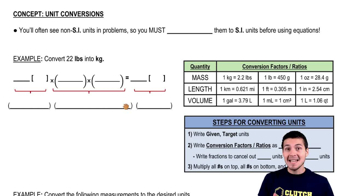
Unit Conversions

Absolute Zero

Absolute zero is the theoretical lowest temperature possible, defined as 0 K or -273.15°C. At this temperature, the motion of atoms theoretically comes to a complete stop. This concept is crucial when discussing temperature scales, as Kelvin is an absolute scale starting from absolute zero, while Celsius and Fahrenheit are relative scales based on the properties of water.
추천 영상:
가이드 코스
07:03
Charges In A Line (Find Zero Force)

Thermal Energy and States of Matter

Temperature is a measure of the average kinetic energy of particles in a substance, influencing its state of matter (solid, liquid, gas). At extremely low temperatures, such as -129°F, substances can become solid, while at high temperatures like 134°F, they may exist as gases. Understanding the relationship between temperature and thermal energy helps in grasping the physical behavior of materials under varying conditions.
추천 영상:
가이드 코스
07:31
Linear Thermal Expansion