A cylinder contains nitrogen gas. A piston compresses the gas to half its initial volume. Afterward, has the mass density of the gas changed? If so, by what factor? If not, why not?
Ch 18: A Macroscopic Description of Matter
18장, 문제 17
A surveyor has a steel measuring tape that is calibrated to be 100.000 m long (i.e., accurate to ±1 mm) at 20°C. If she measures the distance between two stakes to be 65.175 m on a 3°C day, does she need to add or subtract a correction factor to get the true distance? How large, in mm, is the correction factor?
검증된 단계별 안내1
Step 1: Understand the problem. The steel measuring tape expands or contracts with temperature changes due to thermal expansion. The tape is calibrated at 20°C, but the measurement is taken at 3°C. We need to determine the correction factor to account for this temperature difference.
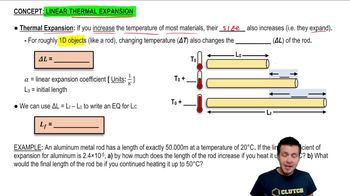
Step 2: Recall the formula for linear thermal expansion: , where is the change in length, is the original length, is the coefficient of linear expansion for steel, and is the temperature change.
Step 3: Calculate the temperature change: . The tape is colder than its calibration temperature, so it contracts.
Step 4: Substitute the values into the formula. Use the coefficient of linear expansion for steel, which is approximately . The original length of the tape is m. The formula becomes: .
Step 5: Interpret the result. The value of will be negative, indicating contraction. Convert the result to millimeters by multiplying by 1000 (since 1 m = 1000 mm). The correction factor should be subtracted from the measured distance to get the true distance.

비슷한 문제에 대한 검증된 영상 답변:
이 영상 해법은 위 문제에 도움이 된다고 튜터들이 추천한 것입니다.
영상 길이:
4m주요 개념
질문에 올바르게 답하기 위해 반드시 이해해야 하는 핵심 개념들은 다음과 같습니다.
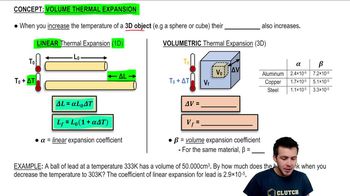
Thermal Expansion
Thermal expansion refers to the tendency of materials to change in size or volume in response to changes in temperature. For metals like steel, this means that as temperature decreases, the material contracts, leading to a shorter length. Understanding this concept is crucial for determining how much the measuring tape's length will change when the temperature drops from 20°C to 3°C.
추천 영상:
가이드 코스
Volume Thermal Expansion
Coefficient of Linear Expansion
The coefficient of linear expansion is a material-specific constant that quantifies how much a unit length of a material expands or contracts per degree change in temperature. For steel, this coefficient is typically around 11 x 10^-6 /°C. This value is essential for calculating the correction factor needed to adjust the measured length of the tape based on the temperature difference.
추천 영상:
가이드 코스
Linear Thermal Expansion
Correction Factor
A correction factor is an adjustment made to account for systematic errors in measurements due to external conditions, such as temperature. In this scenario, the correction factor will be calculated using the change in temperature and the coefficient of linear expansion to determine how much the tape's length has changed, ensuring that the final measurement reflects the true distance between the stakes.
추천 영상:
가이드 코스
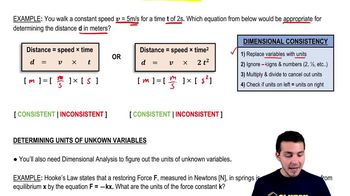
Dimensional Analysis
관련 실천
교과서 질문
1549
views
교과서 질문
A gas at 100°C fills volume V0. If the pressure is held constant, what is the volume if the Celsius temperature is doubled?
1617
views
교과서 질문
A demented scientist creates a new temperature scale, the 'Z scale.' He decides to call the boiling point of nitrogen 0°Z and the melting point of iron 1000°Z. Convert 500°Z to degrees Celsius and to kelvins.
1572
views
교과서 질문
At room temperature (20°C), a 5.0-cm-long brass rod is 20 μm too long to fit into a slot. To what temperature should you cool the rod so that it just barely fits?
1940
views
교과서 질문
The lowest and highest natural temperatures ever recorded on earth are −129°F in Antarctica and 134°F in Death Valley. What are these temperatures in °C and in K?
1918
views
교과서 질문
Common outdoor thermometers are filled with red-colored ethyl alcohol. One thermometer has a 0.40-mm-diameter capillary tube attached to a 9.0-mm-diameter spherical bulb. On a 0°C morning, the column of alcohol stands 30 mm above the bulb. What is the temperature in °C when the column of alcohol stands 130 mm above the bulb? The expansion of the glass is much less than that of the alcohol and can be ignored.
1761
views
1
rank
1
comments