
Ch 19: Work, Heat, and the First Law of Thermodynamics
Knight Calc - Physics for Scientists and Engineers 5th Edition
Knight Calc5th EditionPhysics for Scientists and EngineersISBN: 9780137344796당신이 사용하는 게 아니라요?교과서 변경
19장, 문제 49c

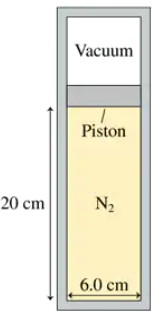
A 6.0-cm-diameter cylinder of nitrogen gas has a 4.0-cm-thick movable copper piston. The cylinder is oriented vertically, as shown in FIGURE P19.49, and the air above the piston is evacuated. When the gas temperature is 20°C, the piston floats 20 cm above the bottom of the cylinder. What is the new equilibrium temperature of the gas?

검증된 단계별 안내
1
Determine the initial state of the gas using the ideal gas law. The ideal gas law is given by: PV=nRT, where P is the pressure, V is the volume, n is the number of moles, R is the gas constant, and T is the temperature. Use the given dimensions of the cylinder and piston to calculate the initial volume of the gas.
Calculate the force acting on the piston due to the weight of the copper piston. The force is given by F=mg, where m is the mass of the piston and g is the acceleration due to gravity. Use the density of copper and the volume of the piston to find its mass.
Relate the pressure of the gas to the force exerted by the piston. The pressure is given by P=FA, where A is the cross-sectional area of the piston. Use the diameter of the cylinder to calculate the area.
Apply the ideal gas law again to find the new equilibrium temperature. Since the piston is movable, the pressure remains constant. The relationship between the initial and final states of the gas can be expressed as: VfVi=TfTi, where Vi and Vf are the initial and final volumes, and Ti and Tf are the initial and final temperatures.
Solve for the final temperature Tf using the relationship derived in the previous step. Substitute the known values for the initial temperature, initial volume, and final volume to find the new equilibrium temperature.

비슷한 문제에 대한 검증된 영상 답변:

이 영상 해법은 위 문제에 도움이 된다고 튜터들이 추천한 것입니다.

주요 개념

질문에 올바르게 답하기 위해 반드시 이해해야 하는 핵심 개념들은 다음과 같습니다.

Ideal Gas Law

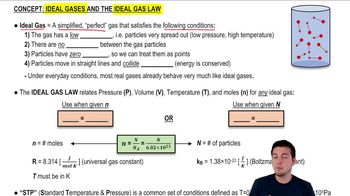
The Ideal Gas Law relates the pressure, volume, temperature, and number of moles of an ideal gas through the equation PV = nRT. This law is essential for understanding how changes in temperature and volume affect the behavior of gases, particularly in scenarios involving pistons and varying pressures.
추천 영상:
가이드 코스
07:21
Ideal Gases and the Ideal Gas Law

Thermal Equilibrium

Thermal equilibrium occurs when two systems reach the same temperature and no heat flows between them. In this context, it is crucial to determine the new equilibrium temperature of the gas after the piston moves, as it will influence the pressure and volume of the gas within the cylinder.
추천 영상:
가이드 코스
05:21
Volume Thermal Expansion

Charles's Law

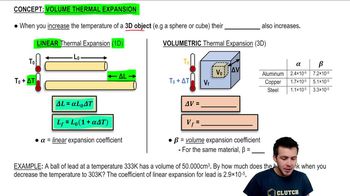
Charles's Law states that the volume of a gas is directly proportional to its temperature when pressure is held constant. This principle is vital for solving the problem, as it allows us to relate the initial and final states of the gas in the cylinder as the piston moves and the temperature changes.
추천 영상:
관련 실천
교과서 질문

A 6.0-cm-diameter cylinder of nitrogen gas has a 4.0-cm-thick movable copper piston. The cylinder is oriented vertically, as shown in FIGURE P19.49, and the air above the piston is evacuated. When the gas temperature is 20°C, the piston floats 20 cm above the bottom of the cylinder. What is the gas pressure?

1473
views
1
rank
교과서 질문

2.0 mol of gas are at 30 °C and a pressure of 1.5 atm. How much work must be done on the gas to compress it to one third of its initial volume at constant pressure?

236
views
교과서 질문

An ideal-gas process is described by p=cV1/2, where c is a constant. Find an expression for the work done on the gas in this process as the volume changes from V1 to V2.

1305
views
교과서 질문

0.25 mol of a gas are compressed at a constant pressure of 250 kPa from 6000 cm3 to 2000 cm3, then expanded at a constant temperature back to 6000 cm3. What is the net work done on the gas?

1406
views
교과서 질문

The beaker in FIGURE P19.45, with a thin metal bottom, is filled with 20 g of water at 20°C. It is brought into good thermal contact with a 4000 cm3 container holding 0.40 mol of a monatomic gas at 10 atm pressure. Both containers are well insulated from their surroundings. What is the gas pressure after a long time has elapsed? You can assume that the containers themselves are nearly massless and do not affect the outcome.

1202
views
교과서 질문

A typical nuclear reactor generates 1000 MW (1000 MJ/s) of electric energy. In doing so, it produces 2000 MW of 'waste heat' that must be removed from the reactor to keep it from melting down. Many reactors are sited next to large bodies of water so that they can use the water for cooling. Consider a reactor where the intake water is at 18°C. State regulations limit the temperature of the output water to 30°C so as not to harm aquatic organisms. How many liters of cooling water have to be pumped through the reactor each minute?

1929
views