Ch 19: Work, Heat, and the First Law of Thermodynamics
Knight Calc - Physics for Scientists and Engineers 5th Edition
Knight Calc5th EditionPhysics for Scientists and EngineersISBN: 9780137344796당신이 사용하는 게 아니라요?교과서 변경
19장, 문제 52a

An ideal-gas process is described by p=cV1/2, where c is a constant. Find an expression for the work done on the gas in this process as the volume changes from V1 to V2.

검증된 단계별 안내
1
Start by recalling the formula for work done on a gas during a process: \( W = \int_{V_1}^{V_2} p \, dV \). Here, \( p \) is the pressure, and \( V \) is the volume.
Substitute the given relationship \( p = cV^{1/2} \) into the work formula. This gives \( W = \int_{V_1}^{V_2} cV^{1/2} \, dV \).
Simplify the integral by factoring out the constant \( c \): \( W = c \int_{V_1}^{V_2} V^{1/2} \, dV \).
Evaluate the integral \( \int V^{1/2} \, dV \) using the power rule for integration: \( \int V^n \, dV = \frac{V^{n+1}}{n+1} \), where \( n = 1/2 \). This results in \( \frac{2}{3} V^{3/2} \).
Substitute the limits of integration \( V_1 \) and \( V_2 \) into the evaluated integral: \( W = c \left[ \frac{2}{3} V^{3/2} \right]_{V_1}^{V_2} = \frac{2c}{3} \left( V_2^{3/2} - V_1^{3/2} \right) \). This is the expression for the work done on the gas.

비슷한 문제에 대한 검증된 영상 답변:

이 영상 해법은 위 문제에 도움이 된다고 튜터들이 추천한 것입니다.
영상 길이:
4m
도움이 되었나요?

주요 개념

질문에 올바르게 답하기 위해 반드시 이해해야 하는 핵심 개념들은 다음과 같습니다.

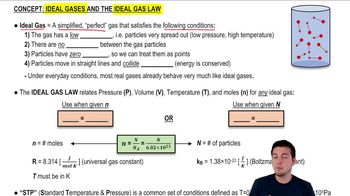
Ideal Gas Law

The Ideal Gas Law relates the pressure, volume, and temperature of an ideal gas through the equation PV = nRT. In this context, understanding how pressure (p) and volume (V) interact is crucial for analyzing the work done during a gas process. The law assumes that gas particles do not interact and occupy no volume, simplifying calculations in thermodynamic processes.
추천 영상:
가이드 코스
07:21
Ideal Gases and the Ideal Gas Law

Work Done by a Gas

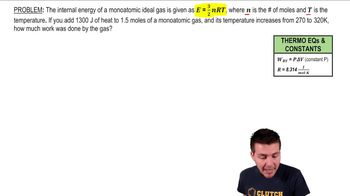
In thermodynamics, the work done on or by a gas during a volume change is calculated using the integral of pressure with respect to volume. For a process where pressure is a function of volume, such as p = cV^2, the work done can be expressed as W = ∫(p dV) from V₁ to V₂. This integral captures the area under the pressure-volume curve, representing the energy transferred during the expansion or compression of the gas.
추천 영상:
가이드 코스
03:47
Calculating Work Done on Monoatomic Gas

Integration in Physics

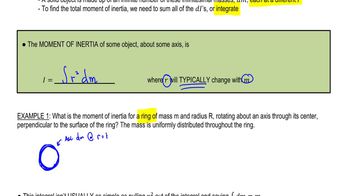
Integration is a fundamental mathematical tool used in physics to calculate quantities that accumulate over a continuous range, such as work done over a changing volume. In the context of the given problem, integrating the pressure function with respect to volume allows us to derive the total work done on the gas as it transitions from one volume to another. Mastery of integration techniques is essential for solving many problems in thermodynamics and mechanics.
추천 영상:
가이드 코스
11:43
Finding Moment Of Inertia By Integrating
관련 실천
교과서 질문

2.0 mol of gas are at 30 °C and a pressure of 1.5 atm. How much work must be done on the gas to compress it to one third of its initial volume at constant pressure?

236
views

교과서 질문

0.25 mol of a gas are compressed at a constant pressure of 250 kPa from 6000 cm3 to 2000 cm3, then expanded at a constant temperature back to 6000 cm3. What is the net work done on the gas?

1406
views
교과서 질문

n moles of an ideal gas at temperature T1 and volume V1 expand isothermally until the volume has doubled. In terms of n, T1, and V1, what is the final temperature?

1307
views
교과서 질문

An ideal-gas process is described by p=cV1/2, where c is a constant. 0.033 mol of gas at an initial temperature of 150°C is compressed, using this process, from 300 cm3 to 200 cm3. How much work is done on the gas?

1155
views
교과서 질문

A 6.0-cm-diameter cylinder of nitrogen gas has a 4.0-cm-thick movable copper piston. The cylinder is oriented vertically, as shown in FIGURE P19.49, and the air above the piston is evacuated. When the gas temperature is 20°C, the piston floats 20 cm above the bottom of the cylinder. What is the new equilibrium temperature of the gas?

1681
views
교과서 질문

A 10-cm-diameter cylinder contains argon gas at 10 atm pressure and a temperature of 50°C. A piston can slide in and out of the cylinder. The cylinder's initial length is 20 cm. 2500 J of heat are transferred to the gas, causing the gas to expand at constant pressure. What are the final length of the cylinder?

286
views