At 100℃ the rms speed of nitrogen molecules is 576 m/s. Nitrogen at 100℃ and a pressure of 2.0 atm is held in a container with a 10 cm x 10 cm square wall. Estimate the rate of molecular collisions (collisions/s) on this wall.
Ch 20: The Micro/Macro Connection
20장, 문제 19
By what factor does the rms speed of a molecule change if the temperature is increased from 10℃ to 1000℃?
검증된 단계별 안내1
Step 1: Understand the relationship between the root mean square (rms) speed of a molecule and temperature. The rms speed is given by the formula: , where is the Boltzmann constant, is the absolute temperature in Kelvin, and the factor of 3 comes from the degrees of freedom in the kinetic energy formula.
Step 2: Convert the given temperatures from Celsius to Kelvin. Use the formula: . For 10℃, the temperature in Kelvin is . For 1000℃, the temperature in Kelvin is .
Step 3: Recognize that the rms speed is proportional to the square root of the temperature. This means the factor by which the rms speed changes can be expressed as: , where is the final temperature and is the initial temperature.
Step 4: Substitute the values of and into the formula. For , use the Kelvin temperature corresponding to 10℃, and for , use the Kelvin temperature corresponding to 1000℃.
Step 5: Simplify the expression to find the factor by which the rms speed changes. This involves calculating the square root of the ratio of the final temperature to the initial temperature.

비슷한 문제에 대한 검증된 영상 답변:
이 영상 해법은 위 문제에 도움이 된다고 튜터들이 추천한 것입니다.
영상 길이:
3m도움이 되었나요?
주요 개념
질문에 올바르게 답하기 위해 반드시 이해해야 하는 핵심 개념들은 다음과 같습니다.
RMS Speed
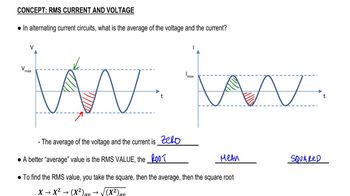
The root mean square (RMS) speed of gas molecules is a measure of the average speed of particles in a gas. It is calculated using the formula v_rms = √(3kT/m), where k is the Boltzmann constant, T is the absolute temperature in Kelvin, and m is the mass of a molecule. This concept is crucial for understanding how temperature affects molecular motion.
추천 영상:
가이드 코스
RMS Current and Voltage
Temperature and Kinetic Energy
Temperature is a measure of the average kinetic energy of the particles in a substance. As temperature increases, the kinetic energy of the molecules also increases, leading to higher speeds. This relationship is fundamental in thermodynamics and helps explain how changes in temperature influence molecular behavior.
추천 영상:
가이드 코스
Intro to Rotational Kinetic Energy
Absolute Temperature Scale
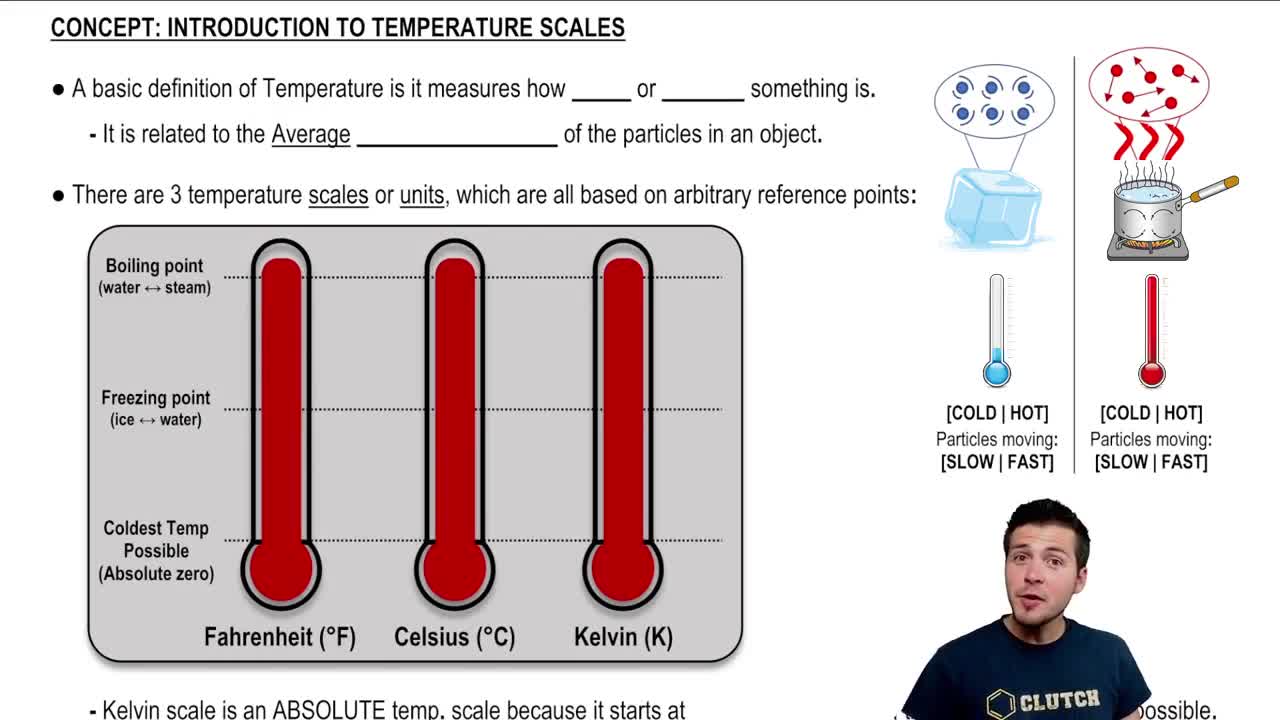
The absolute temperature scale, measured in Kelvin (K), is essential for calculations involving gas laws and molecular speeds. To convert Celsius to Kelvin, you add 273.15. Understanding this scale is necessary for accurately determining the RMS speed when temperatures are given in Celsius.
추천 영상:
가이드 코스
Introduction To Temperature Scales
관련 실천
교과서 질문
2100
views
교과서 질문
A cylinder contains gas at a pressure of 2.0 atm and a number density of 4.2 x 1025 m-3. The rms speed of the atoms is 660 m/s. Identify the gas.
1402
views
교과서 질문
The rms speed of the atoms in a 2.0 g sample of helium gas is 700 m/s. What is the thermal energy of the gas?
1933
views
교과서 질문
Liquid helium boils at 4.2 K. In a flask, the helium gas above the boiling liquid is at the same temperature. What are (a) the mean free path in the gas, (b) the rms speed of the atoms, and (c) the average energy per atom?
1786
views
교과서 질문
1.0 mol of argon has 3100 J of thermal energy. What is the gas temperature in °C?
1862
views
교과서 질문
The rms speed of molecules in a gas is 600 m/s. What will be the rms speed if the gas pressure and volume are both halved?
1850
views