Ch 20: The Micro/Macro Connection
Knight Calc - Physics for Scientists and Engineers 5th Edition
Knight Calc5th EditionPhysics for Scientists and EngineersISBN: 9780137344796당신이 사용하는 게 아니라요?교과서 변경
20장, 문제 1

The mean free path of a molecule in a gas is 300 nm. What will the mean free path be if the gas temperature is doubled at (a) constant volume and (b) constant pressure?

검증된 단계별 안내
1
The mean free path (λ) of a molecule in a gas is given by the formula: λ=1√2πd2n, where d2 is the molecular diameter and n is the number density of molecules. The number density depends on the pressure, temperature, and volume of the gas.
For part (a), at constant volume, the number density n is proportional to PT, where P is pressure and T is temperature. Since the volume is constant and the temperature is doubled, the number density n will decrease by a factor of 2. Substituting this into the formula for mean free path, the mean free path λ will increase by a factor of 2.
For part (b), at constant pressure, the number density n is proportional to 1T. Since the temperature is doubled, the number density n will decrease by a factor of 2. Substituting this into the formula for mean free path, the mean free path λ will increase by a factor of 2.
To summarize, in both cases (a) constant volume and (b) constant pressure, the mean free path will increase by a factor of 2 when the temperature is doubled.
Finally, multiply the initial mean free path (300 nm) by the factor of 2 to determine the new mean free path in each case. This step involves simple multiplication.

비슷한 문제에 대한 검증된 영상 답변:

이 영상 해법은 위 문제에 도움이 된다고 튜터들이 추천한 것입니다.
영상 길이:
5m

주요 개념

질문에 올바르게 답하기 위해 반드시 이해해야 하는 핵심 개념들은 다음과 같습니다.

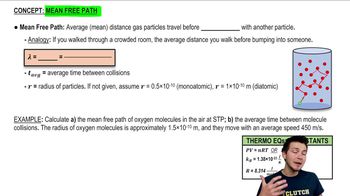
Mean Free Path

The mean free path is the average distance a molecule travels between collisions with other molecules. It is influenced by factors such as the density of the gas and the size of the molecules. In general, a higher density or larger molecules result in a shorter mean free path, while a lower density or smaller molecules lead to a longer mean free path.
추천 영상:

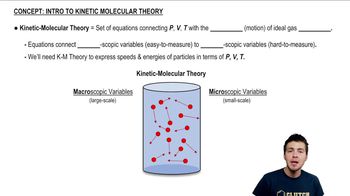
Kinetic Theory of Gases

The kinetic theory of gases describes the behavior of gases in terms of the motion of their molecules. It states that gas temperature is proportional to the average kinetic energy of the molecules. When the temperature of a gas increases, the molecules move faster, which can affect the mean free path depending on whether the volume or pressure is held constant.
추천 영상:
가이드 코스
01:50
Introduction to Kinetic-Molecular Theory

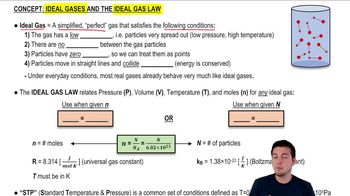
Ideal Gas Law

The ideal gas law relates the pressure, volume, temperature, and number of moles of a gas through the equation PV = nRT. This law helps to understand how changes in temperature affect gas behavior. Under constant volume, increasing temperature leads to increased pressure, while under constant pressure, the volume must increase to accommodate the higher temperature, impacting the mean free path.
추천 영상:
가이드 코스
07:21
Ideal Gases and the Ideal Gas Law