Ch 20: The Micro/Macro Connection
Knight Calc - Physics for Scientists and Engineers 5th Edition
Knight Calc5th EditionPhysics for Scientists and EngineersISBN: 9780137344796당신이 사용하는 게 아니라요?교과서 변경
20장, 문제 5

Integrated circuits are manufactured in vacuum chambers in which the air pressure is 1.0 x 10⁻¹⁰ of Hg. What are (a) the number density and (b) the mean free path of a molecule? Assume T = 20℃.

검증된 단계별 안내
1
Convert the given pressure from mmHg to Pascals (Pa) using the conversion factor: 1 mmHg = 133.322 Pa. The pressure in Pascals is given by \( P = (1.0 \times 10^{-10}) \times 133.322 \).
Use the ideal gas law \( PV = nRT \) to find the number density \( n/V \), where \( n/V = P / (RT) \). Here, \( R \) is the universal gas constant (8.314 J/(mol·K)), and \( T \) is the temperature in Kelvin. Convert the temperature from Celsius to Kelvin using \( T(K) = T(°C) + 273.15 \).
Substitute the values of \( P \), \( R \), and \( T \) into the formula \( n/V = P / (RT) \) to calculate the number density of molecules per unit volume.
To calculate the mean free path \( \lambda \), use the formula \( \lambda = \frac{k_B T}{\sqrt{2} \pi d^2 P} \), where \( k_B \) is the Boltzmann constant (1.38 \(\times\) 10^{-23} J/K), \( d \) is the diameter of a molecule (assume a typical value for air molecules, approximately 3.7 \(\times\) 10^{-10} m), and \( P \) is the pressure in Pascals.
Substitute the values of \( k_B \), \( T \), \( d \), and \( P \) into the formula for \( \lambda \) to determine the mean free path of a molecule in the vacuum chamber.

비슷한 문제에 대한 검증된 영상 답변:

이 영상 해법은 위 문제에 도움이 된다고 튜터들이 추천한 것입니다.
영상 길이:
5m
도움이 되었나요?

주요 개념

질문에 올바르게 답하기 위해 반드시 이해해야 하는 핵심 개념들은 다음과 같습니다.

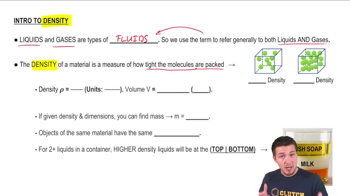
Number Density

Number density refers to the number of particles (molecules, atoms, etc.) per unit volume in a given space. It is typically expressed in units such as particles per cubic meter. In the context of the question, calculating the number density of air molecules at a specific pressure involves using the ideal gas law, which relates pressure, volume, and temperature to the number of particles.
추천 영상:
가이드 코스
8:13
Intro to Density

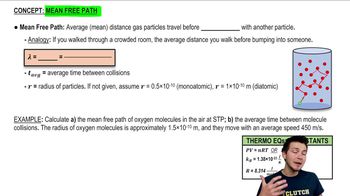
Mean Free Path

The mean free path is the average distance a molecule travels between collisions with other molecules. It is influenced by the number density of the molecules and their effective cross-sectional area for collisions. In low-pressure environments, such as the vacuum chamber mentioned, the mean free path increases significantly, allowing molecules to travel longer distances without colliding.
추천 영상:

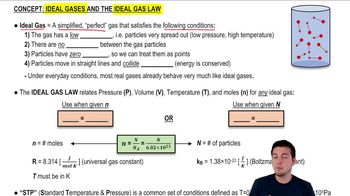
Ideal Gas Law

The ideal gas law is a fundamental equation in thermodynamics that describes the behavior of ideal gases. It is expressed as PV = nRT, where P is pressure, V is volume, n is the number of moles, R is the ideal gas constant, and T is temperature in Kelvin. This law is essential for calculating properties like number density and mean free path, especially when dealing with gases at various pressures and temperatures.
추천 영상:
가이드 코스
07:21
Ideal Gases and the Ideal Gas Law
관련 실천
교과서 질문

A cylinder of nitrogen and a cylinder of neon are at the same temperature and pressure. The mean free path of a nitrogen molecule is 150 nm. What is the mean free path of a neon atom?

1703
views

교과서 질문

The mean free path of a molecule in a gas is 300 nm. What will the mean free path be if the gas temperature is doubled at (a) constant volume and (b) constant pressure?

1830
views
교과서 질문

The molecules in a six-particle gas have velocities:

v1=(20i^30j^) m/sv2=(40i^+70j^) m/sv3=(80i^+20j^) m/sv4=30i^ m/sv5=(40i^40j^) m/sv6=(50i^20j^) m/s \(\begin{aligned}\) \(\vec{v}\)_1 &= (20\(\hat{i}\) - 30\(\hat{j}\)) \(\text{ m/s}\) \\ \(\vec{v}\)_2 &= (40\(\hat{i}\) + 70\(\hat{j}\)) \(\text{ m/s}\) \\ \(\vec{v}\)_3 &= (-80\(\hat{i}\) + 20\(\hat{j}\)) \(\text{ m/s}\) \\ \(\vec{v}\)_4 &= 30\(\hat{i}\) \(\text{ m/s}\) \\ \(\vec{v}\)_5 &= (40\(\hat{i}\) - 40\(\hat{j}\)) \(\text{ m/s}\) \\ \(\vec{v}\)_6 &= (-50\(\hat{i}\) - 20\(\hat{j}\)) \(\text{ m/s}\) \(\end{aligned}\)

Calculate (a) vavg\(\vec{v}\)_{\(\text{avg}\)}, (b) vavgv_{\(\text{avg}\)}, and (c) vrmsv_{\(\text{rms}\)}.

1762
views
교과서 질문

A 1.0 m ✕ 1.0 m ✕ 1.0 m cube of nitrogen gas is at 20℃ and 1.0 atm. Estimate the number of molecules in the cube with a speed between 700 m/s and 1000 m/s.

1801
views
교과서 질문

Eleven molecules have speeds 15, 16, 17, …, 25 m/s. Calculate (a) vavg and (b) vrms.

1247
views