Ch 20: The Micro/Macro Connection
Knight Calc - Physics for Scientists and Engineers 5th Edition
Knight Calc5th EditionPhysics for Scientists and EngineersISBN: 9780137344796당신이 사용하는 게 아니라요?교과서 변경
20장, 문제 9

The molecules in a six-particle gas have velocities:
v1=(20i^30j^) m/sv2=(40i^+70j^) m/sv3=(80i^+20j^) m/sv4=30i^ m/sv5=(40i^40j^) m/sv6=(50i^20j^) m/s \(\begin{aligned}\) \(\vec{v}\)_1 &= (20\(\hat{i}\) - 30\(\hat{j}\)) \(\text{ m/s}\) \\ \(\vec{v}\)_2 &= (40\(\hat{i}\) + 70\(\hat{j}\)) \(\text{ m/s}\) \\ \(\vec{v}\)_3 &= (-80\(\hat{i}\) + 20\(\hat{j}\)) \(\text{ m/s}\) \\ \(\vec{v}\)_4 &= 30\(\hat{i}\) \(\text{ m/s}\) \\ \(\vec{v}\)_5 &= (40\(\hat{i}\) - 40\(\hat{j}\)) \(\text{ m/s}\) \\ \(\vec{v}\)_6 &= (-50\(\hat{i}\) - 20\(\hat{j}\)) \(\text{ m/s}\) \(\end{aligned}\)
Calculate (a) vavg\(\vec{v}\)_{\(\text{avg}\)}, (b) vavgv_{\(\text{avg}\)}, and (c) vrmsv_{\(\text{rms}\)}.

검증된 단계별 안내
1
Step 1: To calculate the average velocity vector (→vₐᵥ₉), sum up all the velocity vectors of the six particles. Use the formula: →vₐᵥ₉ = (1/N) * Σ→vᵢ, where N is the total number of particles (6 in this case) and →vᵢ are the individual velocity vectors. Perform the summation component-wise for the î and ĵ components.
Step 2: To calculate the magnitude of the average velocity vector (vₐᵥ₉), use the formula: vₐᵥ₉ = √((vₐᵥ₉ₓ)² + (vₐᵥ₉ᵧ)²), where vₐᵥ₉ₓ and vₐᵥ₉ᵧ are the x and y components of →vₐᵥ₉, respectively. These components are obtained from Step 1.
Step 3: To calculate the root-mean-square speed (vᵣₘₛ), first find the magnitude of each velocity vector (vᵢ) using the formula: vᵢ = √(vᵢₓ² + vᵢᵧ²), where vᵢₓ and vᵢᵧ are the x and y components of the velocity vector →vᵢ. Perform this calculation for all six particles.
Step 4: Compute the mean of the squared magnitudes of the velocities using the formula: mean(vᵢ²) = (1/N) * Σ(vᵢ²), where vᵢ² is the square of the magnitude of each velocity vector calculated in Step 3, and N is the total number of particles (6).
Step 5: Finally, calculate the root-mean-square speed (vᵣₘₛ) using the formula: vᵣₘₛ = √(mean(vᵢ²)). This gives the root-mean-square speed of the gas particles.

비슷한 문제에 대한 검증된 영상 답변:

이 영상 해법은 위 문제에 도움이 된다고 튜터들이 추천한 것입니다.
영상 길이:
11m

주요 개념

질문에 올바르게 답하기 위해 반드시 이해해야 하는 핵심 개념들은 다음과 같습니다.

Vector Addition

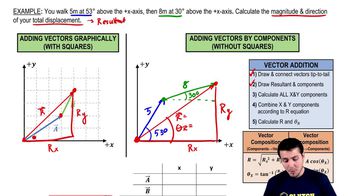
Vector addition is the process of combining two or more vectors to determine a resultant vector. In this context, the velocities of the gas molecules are represented as vectors, and their average velocity can be found by summing all individual velocity vectors and dividing by the number of vectors. This operation takes into account both the magnitude and direction of each vector.
추천 영상:
가이드 코스
07:30
Vector Addition By Components

Average Velocity

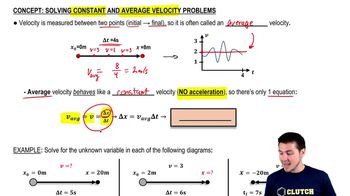
Average velocity is defined as the total displacement divided by the total time taken. For a system of particles, it can be calculated by taking the vector sum of all individual velocities and dividing by the number of particles. This provides a single vector that represents the overall motion of the gas molecules in the system.
추천 영상:
가이드 코스
05:44
Solving Constant and Average Velocity Problems

Root Mean Square Velocity

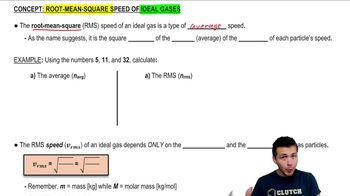
Root mean square (RMS) velocity is a statistical measure of the speed of particles in a gas. It is calculated by taking the square root of the average of the squares of the individual velocities. This concept is particularly useful in thermodynamics and kinetic theory, as it relates to the temperature and energy of the gas particles.
추천 영상:
가이드 코스
05:21
Root-Mean-Square Speed of Ideal Gases