Two 1.0 g spheres are charged equally and placed 2.0 cm apart. When released, they begin to accelerate at 150 m/s2. What is the magnitude of the charge on each sphere?
Ch 22: Electric Charges and Forces
22장, 문제 34b
A 0.10 g honeybee acquires a charge of +23 pC while flying. What electric field (strength and direction) would allow the bee to hang suspended in the air?
검증된 단계별 안내1
Step 1: Begin by identifying the forces acting on the honeybee. The honeybee is suspended in the air, meaning the electric force acting on it must balance the gravitational force. The gravitational force can be calculated using the formula: , where is the mass of the honeybee and is the acceleration due to gravity (approximately 9.8 m/s²).
Step 2: Calculate the gravitational force acting on the honeybee. Convert the mass of the honeybee from grams to kilograms (0.10 g = 0.0001 kg) and substitute it into the formula for gravitational force: . This gives the magnitude of the gravitational force.
Step 3: Recall the formula for electric force: , where is the charge on the honeybee and is the electric field strength. To suspend the honeybee, the electric force must equal the gravitational force: . Substitute the expression for into this equation: .
Step 4: Solve for the electric field strength . Rearrange the equation to isolate : . Substitute the values for (0.0001 kg), (9.8 m/s²), and (+23 pC = 23 × 10⁻¹² C).
Step 5: Determine the direction of the electric field. Since the honeybee has a positive charge, the electric field must point upward to exert an upward force on the honeybee, counteracting the downward gravitational force. This ensures the honeybee remains suspended in the air.

비슷한 문제에 대한 검증된 영상 답변:
이 영상 해법은 위 문제에 도움이 된다고 튜터들이 추천한 것입니다.
영상 길이:
7m도움이 되었나요?
주요 개념
질문에 올바르게 답하기 위해 반드시 이해해야 하는 핵심 개념들은 다음과 같습니다.
Electric Field
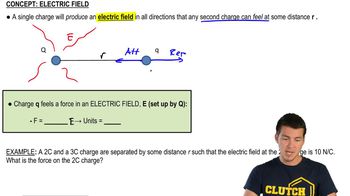
An electric field is a region around a charged particle where other charged particles experience a force. It is represented by the symbol E and is measured in newtons per coulomb (N/C). The direction of the electric field is defined as the direction a positive test charge would move in the field. Understanding electric fields is crucial for analyzing the forces acting on charged objects, such as the honeybee in this scenario.
추천 영상:
가이드 코스
Intro to Electric Fields
Force on a Charged Particle
The force experienced by a charged particle in an electric field is given by Coulomb's law, expressed as F = qE, where F is the force, q is the charge of the particle, and E is the electric field strength. This relationship indicates that the force is directly proportional to both the charge and the strength of the electric field. In the case of the honeybee, this force must counteract its weight to achieve suspension in the air.
추천 영상:
가이드 코스
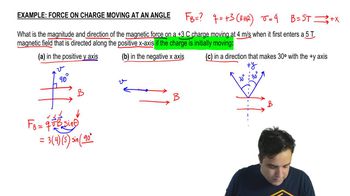
Force on Charge Moving at an Angle
Weight of the Honeybee
The weight of an object is the force exerted on it due to gravity, calculated as W = mg, where m is the mass and g is the acceleration due to gravity (approximately 9.81 m/s² on Earth). For the honeybee, with a mass of 0.10 g (or 0.0001 kg), its weight must be determined to find the necessary electric field that will balance this force, allowing the bee to remain suspended in the air.
추천 영상:
가이드 코스
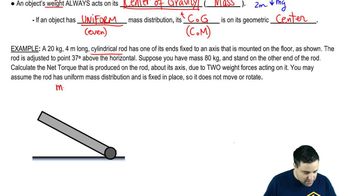
Torque Due to Weight
관련 실천
교과서 질문
1525
views
교과서 질문
A 3.00-cm-long spring has a small plastic bead glued to each end. Charging each bead to −25 nC expands the spring by 0.50 cm. What is the value of the spring constant?
1496
views
교과서 질문
The electric field at a point in space is N/C. What is the electric force on a proton at this point? Give your answer in component form.
1958
views
교과서 질문
The electric field at a point in space is N/C. What is the magnitude of the electron’s acceleration?
189
views
교과서 질문
Objects A and B are both positively charged. Both have a mass of 100 g, but A has twice the charge of B. When A and B are placed 10 cm apart, B experiences an electric force of 0.45 N. What is the charge on A?
1789
views
교과서 질문
A charge is located at . What are the electric fields at the positions , and ? Write each electric field vector in component form.
2423
views