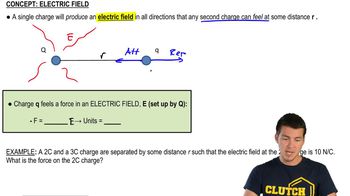
What are the strength and direction of the electric field 1.0 mm from a proton?
Ch 22: Electric Charges and Forces
22장, 문제 32
A charge is located at . What are the electric fields at the positions , and ? Write each electric field vector in component form.
검증된 단계별 안내1
Step 1: Recall the formula for the electric field due to a point charge: , where is Coulomb's constant (), is the charge, and is the distance between the charge and the point where the field is being calculated.
Step 2: Convert all distances to meters. The charge is located at (1.0 cm, 0 cm), which is (0.01 m, 0 m). The positions where the electric field is to be calculated are (5.0 cm, 0 cm) = (0.05 m, 0 m), (−5.0 cm, 0 cm) = (−0.05 m, 0 m), and (0 cm, 5.0 cm) = (0 m, 0.05 m).
Step 3: Calculate the distance between the charge and each point. For example, for (5.0 cm, 0 cm), , where and . Repeat this for the other two points.
Step 4: Determine the direction of the electric field. The electric field vector points away from the charge if it is positive and toward the charge if it is negative. Since the charge is , the electric field vectors will point toward the charge. Use the relative positions of the charge and the points to determine the components of the electric field vector.
Step 5: Substitute the values of , , and into the formula for the electric field. For each point, calculate the magnitude of the electric field and then resolve it into components based on the direction determined in Step 4. Write the electric field vectors in component form for each position.

비슷한 문제에 대한 검증된 영상 답변:
이 영상 해법은 위 문제에 도움이 된다고 튜터들이 추천한 것입니다.
영상 길이:
8m주요 개념
질문에 올바르게 답하기 위해 반드시 이해해야 하는 핵심 개념들은 다음과 같습니다.
Electric Field
The electric field is a vector field that represents the force exerted by an electric charge on other charges in its vicinity. It is defined as the force per unit charge experienced by a positive test charge placed in the field. The direction of the electric field is away from positive charges and towards negative charges, and its magnitude decreases with distance from the charge.
추천 영상:
가이드 코스
Intro to Electric Fields
Coulomb's Law
Coulomb's Law describes the electrostatic interaction between charged particles. It states that the force between two point charges is directly proportional to the product of the magnitudes of the charges and inversely proportional to the square of the distance between them. This law is fundamental for calculating the electric field generated by a point charge at a given location.
추천 영상:
가이드 코스
Coulomb's Law
Vector Components
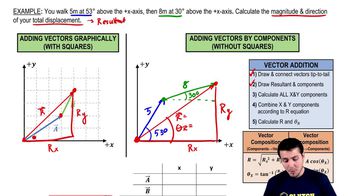
Vectors can be broken down into their components along the coordinate axes, typically x and y in two-dimensional space. This decomposition allows for easier calculations and analysis of vector quantities, such as electric fields. The electric field vector can be expressed in component form as E = (Ex, Ey), where Ex and Ey are the electric field strengths in the x and y directions, respectively.
추천 영상:
가이드 코스
Vector Addition By Components
관련 실천
교과서 질문
1811
views
교과서 질문
A 0.10 g honeybee acquires a charge of +23 pC while flying. What electric field (strength and direction) would allow the bee to hang suspended in the air?
1671
views
교과서 질문
Two 1.0 g spheres are charged equally and placed 2.0 cm apart. When released, they begin to accelerate at 150 m/s2. What is the magnitude of the charge on each sphere?
1525
views
교과서 질문
A 3.00-cm-long spring has a small plastic bead glued to each end. Charging each bead to −25 nC expands the spring by 0.50 cm. What is the value of the spring constant?
1496
views
교과서 질문
The electric field at a point in space is N/C. What is the electric force on a proton at this point? Give your answer in component form.
1958
views
교과서 질문
The electric field at a point in space is N/C. What is the magnitude of the electron’s acceleration?
189
views