Ch 22: Electric Charges and Forces
Knight Calc - Physics for Scientists and Engineers 5th Edition
Knight Calc5th EditionPhysics for Scientists and EngineersISBN: 9780137344796당신이 사용하는 게 아니라요?교과서 변경
22장, 문제 3b

A plastic rod that has been charged to −15 nC touches a metal sphere. Afterward, the rod's charge is −10 nC. How many charged particles were transferred?

검증된 단계별 안내
1
Determine the change in charge on the plastic rod. The initial charge on the rod is \(-15 \; \text{nC}\), and the final charge is \(-10 \; \text{nC}\). The change in charge is given by \(\Delta Q = Q_{\text{final}} - Q_{\text{initial}}\).
Substitute the values into the formula: \(\Delta Q = -10 \; \text{nC} - (-15 \; \text{nC})\). Simplify the expression to find the total charge transferred.
Recall that the charge of a single electron is \(e = -1.6 \times 10^{-19} \; \text{C}\). The number of charged particles (electrons) transferred can be calculated using the formula \(n = \frac{\Delta Q}{e}\), where \(n\) is the number of electrons.
Substitute the value of \(\Delta Q\) (calculated in step 2) and \(e = -1.6 \times 10^{-19} \; \text{C}\) into the formula \(n = \frac{\Delta Q}{e}\).
Simplify the expression to find the number of electrons transferred. Note that the result should be a positive value, as the number of particles is always positive.

비슷한 문제에 대한 검증된 영상 답변:

이 영상 해법은 위 문제에 도움이 된다고 튜터들이 추천한 것입니다.
영상 길이:
3m
도움이 되었나요?

주요 개념

질문에 올바르게 답하기 위해 반드시 이해해야 하는 핵심 개념들은 다음과 같습니다.

Charge Conservation

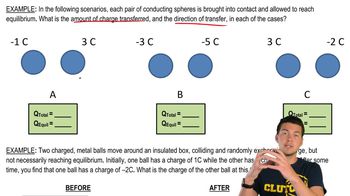
Charge conservation is a fundamental principle in physics stating that the total electric charge in an isolated system remains constant over time. When two objects come into contact, charge can be transferred between them, but the sum of their charges before and after the interaction must remain the same. This principle is crucial for understanding how charges redistribute when conductive materials interact.
추천 영상:
가이드 코스
05:43
Conservation of Charge

Coulomb's Law

Coulomb's Law describes the electrostatic force between two charged objects. It states that the force is directly proportional to the product of the magnitudes of the charges and inversely proportional to the square of the distance between them. This law helps explain how charged particles interact and can be used to calculate the forces involved when charges are transferred between objects.
추천 영상:

Elementary Charge

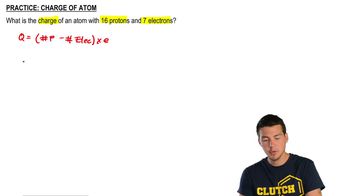
The elementary charge is the smallest unit of electric charge, denoted as 'e', approximately equal to 1.6 x 10^-19 coulombs. It is the charge carried by a single proton or the negative of that carried by a single electron. Understanding the elementary charge is essential for calculating the number of charged particles transferred during interactions, as charges are quantized and always occur in integer multiples of this fundamental charge.
추천 영상: