
Ch 22: Electric Charges and Forces
Knight Calc - Physics for Scientists and Engineers 5th Edition
Knight Calc5th EditionPhysics for Scientists and EngineersISBN: 9780137344796당신이 사용하는 게 아니라요?교과서 변경
22장, 문제 80c

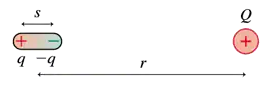
In Section 22.3 we claimed that a charged object exerts a net attractive force on an electric dipole. Let's investigate this. FIGURE CP22.80 shows a permanent electric dipole consisting of charges +q and −q separated by the fixed distance s. Charge +Q is distance r from the center of the dipole. We'll assume, as is usually the case in practice, that s≪r. Use the binomial approximation (1+x)n1nx(1+x)^{-n}\(\thickapprox\)1-nx if x≪1 to show that your expression from part a can be written Fnet=2KqQs/r3F_{net}=2KqQs/r^3.
Diagram of a permanent electric dipole with charges +q and -q separated by distance s, and charge +Q at distance r.

검증된 단계별 안내
1
Step 1: Begin by analyzing the forces exerted by the charge +Q on the dipole. The dipole consists of two charges, +q and -q, separated by a fixed distance s. The force on +q is attractive, while the force on -q is repulsive. These forces are not equal in magnitude due to the difference in distances from +Q.
Step 2: Write the expressions for the forces on +q and -q due to +Q using Coulomb's law. The force on +q is given by F_{+q} = K(Qq)/(r-s/2)^2, and the force on -q is given by F_{-q} = K(Qq)/(r+s/2)^2, where K is Coulomb's constant.
Step 3: Calculate the net force on the dipole by subtracting the force on -q from the force on +q. This gives F_{net} = F_{+q} - F_{-q} = K(Qq)/(r-s/2)^2 - K(Qq)/(r+s/2)^2.
Step 4: Apply the binomial approximation (1+x)^{-n} ≈ 1 - nx for x ≪ 1 to simplify the denominators. For (r-s/2)^2 and (r+s/2)^2, expand the terms using the approximation, assuming s ≪ r. This leads to simplified expressions for the forces.
Step 5: Combine the simplified expressions to find the net force. After applying the binomial approximation and simplifying, the net force on the dipole is found to be F_{net} = 2KqQs/r^3, which shows the dependence on the cube of the distance r and the separation s.

비슷한 문제에 대한 검증된 영상 답변:

이 영상 해법은 위 문제에 도움이 된다고 튜터들이 추천한 것입니다.
도움이 되었나요?

주요 개념

질문에 올바르게 답하기 위해 반드시 이해해야 하는 핵심 개념들은 다음과 같습니다.

Electric Dipole

An electric dipole consists of two equal and opposite charges, +q and -q, separated by a distance s. The dipole moment, a vector quantity, is defined as the product of the charge and the separation distance, pointing from the negative to the positive charge. Electric dipoles create an electric field in their vicinity, which influences other charges, such as a charge +Q placed at a distance r from the dipole.
추천 영상:
가이드 코스
03:08
Intro To Dipole Moment

Net Force on a Dipole

When a charged object, like +Q, is placed near an electric dipole, it experiences a net force due to the interaction between the dipole's electric field and the charge. The force is attractive if the dipole is oriented such that its positive end faces the positive charge. The net force can be derived using Coulomb's law and depends on the distance r from the dipole and the separation s of the charges within the dipole.
추천 영상:
가이드 코스
03:08
Intro To Dipole Moment

Binomial Approximation

The binomial approximation is a mathematical simplification used when dealing with expressions of the form (1 + x)^n, particularly when x is much smaller than 1. It allows us to approximate (1 + x)^n as 1 + nx for small values of x. In the context of electric dipoles, this approximation helps simplify calculations involving the forces acting on the dipole when the distance r is much larger than the separation s, making it easier to derive expressions for the net force.
추천 영상:
가이드 코스
03:46
Index of Refraction