
Ch 22: Electric Charges and Forces
Knight Calc - Physics for Scientists and Engineers 5th Edition
Knight Calc5th EditionPhysics for Scientists and EngineersISBN: 9780137344796당신이 사용하는 게 아니라요?교과서 변경
22장, 문제 71

A 5.0 g ball charged to 1.5 μC is tied to a 25-cm-long string. It swings at 250 rpm in a horizontal circle around a stationary ball charged to −2.5 μC. What is the tension in the string?

검증된 단계별 안내
1
Convert all given quantities to SI units: mass of the ball (m = 5.0 g = 0.005 kg), charge of the moving ball (q₁ = 1.5 μC = 1.5 × 10⁻⁶ C), charge of the stationary ball (q₂ = -2.5 μC = -2.5 × 10⁻⁶ C), string length (r = 25 cm = 0.25 m), and angular velocity (ω = 250 rpm = (250 × 2π) / 60 rad/s).
Determine the centripetal force required to keep the ball moving in a horizontal circle. The centripetal force is provided by the horizontal component of the tension in the string. Use the formula for centripetal force: F_c = m * r * ω².
Calculate the electrostatic force between the two charges using Coulomb's law: F_e = (k * |q₁ * q₂|) / r², where k is Coulomb's constant (k = 8.99 × 10⁹ N·m²/C²). This force acts along the line connecting the two charges.
Resolve the tension in the string into two components: the horizontal component (T_h) provides the centripetal force (T_h = F_c), and the vertical component (T_v) balances the weight of the ball (T_v = m * g, where g = 9.8 m/s²).
Combine the components of tension to find the total tension in the string using the Pythagorean theorem: T = √(T_h² + T_v²). Substitute the expressions for T_h and T_v to calculate the total tension.

비슷한 문제에 대한 검증된 영상 답변:

이 영상 해법은 위 문제에 도움이 된다고 튜터들이 추천한 것입니다.
영상 길이:
7m

주요 개념

질문에 올바르게 답하기 위해 반드시 이해해야 하는 핵심 개념들은 다음과 같습니다.

Centripetal Force

Centripetal force is the net force required to keep an object moving in a circular path, directed towards the center of the circle. In this scenario, the tension in the string provides the necessary centripetal force to keep the charged ball moving in a horizontal circle. The formula for centripetal force is F_c = m(v^2/r), where m is the mass, v is the tangential speed, and r is the radius of the circle.
추천 영상:
가이드 코스
06:48
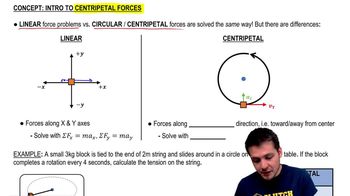
Intro to Centripetal Forces

Electric Force

The electric force is the attractive or repulsive force between charged objects, described by Coulomb's Law. In this case, the charged stationary ball exerts an electric force on the swinging ball, which affects the net force acting on it. The magnitude of the electric force can be calculated using F_e = k * |q1 * q2| / r^2, where k is Coulomb's constant, and q1 and q2 are the charges of the two balls.
추천 영상:
가이드 코스
14:21
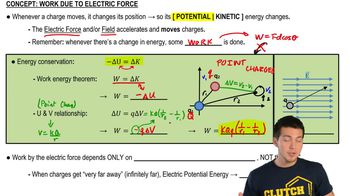
Work due to Electric Force

Tension in a String

Tension is the force transmitted through a string, rope, or cable when it is pulled tight by forces acting from opposite ends. In this problem, the tension in the string must balance both the centripetal force required for circular motion and the electric force acting on the charged ball. The net force acting on the ball can be expressed as T - F_e = F_c, where T is the tension, F_e is the electric force, and F_c is the centripetal force.
추천 영상:
가이드 코스
04:39
Energy & Power of Waves on Strings
관련 실천
교과서 질문

In Section 22.3 we claimed that a charged object exerts a net attractive force on an electric dipole. Let's investigate this. FIGURE CP22.80 shows a permanent electric dipole consisting of charges +q and −q separated by the fixed distance s. Charge +Q is distance r from the center of the dipole. We'll assume, as is usually the case in practice, that s≪r. Use the binomial approximation (1+x)−n≈1−nx(1+x)^{-n}\(\thickapprox\)1-nx if x≪1 to show that your expression from part a can be written Fnet=2KqQs/r3F_{net}=2KqQs/r^3.

215
views
교과서 질문

A small 1.0 g block charged to 75 nC is placed on a 30° inclined plane. The coefficients of static and kinetic friction are 0.20 and 0.10, respectively. What minimum strength horizontal electric field is needed to keep the block from sliding down the plane?

2776
views
1
rank
교과서 질문

Space explorers discover an 8.7×10¹⁷ kg asteroid that happens to have a positive charge of 4400 C. They would like to place their 3.3×10⁵ kg spaceship in orbit around the asteroid. Interestingly, the solar wind has given their spaceship a charge of −1.2C. What speed must their spaceship have to achieve a 7500-km-diameter circular orbit?

1839
views
교과서 질문

An electric field E→=200,000i^\(\overrightarrow{E}\)=200,000\(\hat{i}\) N/C causes the point charge in FIGURE P22.68 to hang at an angle. What is θ?

2495
views
1
rank
1
comments
교과서 질문

Three 1.0 nC charges are placed as shown in FIGURE P22.66. Each of these charges creates an electric field E at a point 3.0 cm in front of the middle charge. What are the three fields E₁, E₂, and E₃ created by the three charges? Write your answer for each as a vector in component form.

1579
views
교과서 질문

Starting from rest, how long does it take an electron to move 1.0 cm in a steady electric field of magnitude 100 N/C?

1747
views