
Ch 25: The Electric Potential
Knight Calc - Physics for Scientists and Engineers 5th Edition
Knight Calc5th EditionPhysics for Scientists and EngineersISBN: 9780137344796당신이 사용하는 게 아니라요?교과서 변경
25장, 문제 43

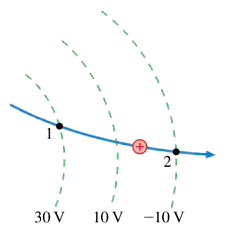
A proton's speed as it passes point 1 is 50,000 m/s. It follows the trajectory shown in FIGURE P25.43. What is the proton's speed at point 2?
Diagram showing a proton's trajectory between two points, with electric potential values labeled at each point.

검증된 단계별 안내
1
Identify the principle of energy conservation: The total mechanical energy of the proton (kinetic energy + electric potential energy) remains constant if no non-conservative forces (like friction) are acting on it.
Write the expression for the total energy at point 1: \( E_1 = \frac{1}{2} m v_1^2 + q V_1 \), where \( m \) is the mass of the proton, \( v_1 \) is its speed at point 1, \( q \) is the charge of the proton, and \( V_1 \) is the electric potential at point 1.
Write the expression for the total energy at point 2: \( E_2 = \frac{1}{2} m v_2^2 + q V_2 \), where \( v_2 \) is the speed of the proton at point 2 and \( V_2 \) is the electric potential at point 2.
Set \( E_1 = E_2 \) because energy is conserved. This gives \( \frac{1}{2} m v_1^2 + q V_1 = \frac{1}{2} m v_2^2 + q V_2 \).
Rearrange the equation to solve for \( v_2 \): \( v_2 = \sqrt{v_1^2 + \frac{2q}{m} (V_1 - V_2)} \). Substitute the known values for \( v_1 \), \( q \), \( m \), \( V_1 \), and \( V_2 \) to calculate the final speed.

비슷한 문제에 대한 검증된 영상 답변:

이 영상 해법은 위 문제에 도움이 된다고 튜터들이 추천한 것입니다.
도움이 되었나요?

주요 개념

질문에 올바르게 답하기 위해 반드시 이해해야 하는 핵심 개념들은 다음과 같습니다.

Conservation of Energy

The principle of conservation of energy states that the total energy in a closed system remains constant over time. In the context of a proton moving through a field, its kinetic energy and potential energy can interchange, but their sum will remain the same. This concept is crucial for determining the speed of the proton at different points along its trajectory.
추천 영상:
가이드 코스
06:24
Conservation Of Mechanical Energy

Kinetic Energy

Kinetic energy is the energy an object possesses due to its motion, calculated using the formula KE = 1/2 mv², where m is mass and v is velocity. For the proton, its initial speed at point 1 contributes to its kinetic energy, which can change as it moves through different potential energy regions. Understanding how kinetic energy varies helps in calculating the speed at point 2.
추천 영상:
가이드 코스
06:07
Intro to Rotational Kinetic Energy

Electric Potential Energy

Electric potential energy is the energy a charged particle has due to its position in an electric field. As the proton moves through the field, its potential energy changes, affecting its speed. The relationship between potential energy and kinetic energy is essential for solving the problem, as it allows us to determine how the proton's speed changes from point 1 to point 2.
추천 영상:
가이드 코스
07:51
Electric Potential Energy
관련 실천
교과서 질문

The electron gun in an old TV picture tube accelerates electrons between two parallel plates 1.2 cm apart with a 25 kV potential difference between them. The electrons enter through a small hole in the negative plate, accelerate, then exit through a small hole in the positive plate. Assume that the holes are small enough not to affect the electric field or potential. With what speed does an electron exit the electron gun if its entry speed is close to zero?

132
views
교과서 질문

An arrangement of source charges produces the electric potential V=5000x2 along the x-axis, where V is in volts and x is in meters. What is the maximum speed of a 1.0 g, 10 nC charged particle that moves in this potential with turning points at ±8.0 cm?

1754
views
교과서 질문

A −3.0 nC charge is on the x-axis at x=−9 cm and a +4.0 nC charge is on the x-axis at x=16 cm. At what point or points on the y-axis is the electric potential zero?

2524
views
1
rank
교과서 질문

Two small metal cubes with masses 2.0 g and 4.0 g are tied together by a 5.0-cm-long massless string and are at rest on a frictionless surface. Each is charged to +2.0 μC. What is the tension in the string?

1911
views
교과서 질문

The four 1.0 g spheres shown in FIGURE P25.42 are released simultaneously and allowed to move away from each other. What is the speed of each sphere when they are very far apart?

2586
views
1
rank
교과서 질문

Living cells 'pump' singly ionized sodium ions, Na+, from the inside of the cell to the outside to maintain a membrane potential ΔVmembrane=Vin−Vout=−70 mV. It is called pumping because work must be done to move a positive ion from the negative inside of the cell to the positive outside, and it must go on continuously because sodium ions 'leak' back through the cell wall by diffusion. At rest, the human body uses energy at the rate of approximately 100 W to maintain basic metabolic functions. It has been estimated that 20% of this energy is used to operate the sodium pumps of the body. Estimate—to one significant figure—the number of sodium ions pumped per second.

1840
views
1
rank