Ch 25: The Electric Potential
Knight Calc - Physics for Scientists and Engineers 5th Edition
Knight Calc5th EditionPhysics for Scientists and EngineersISBN: 9780137344796당신이 사용하는 게 아니라요?교과서 변경
25장, 문제 41

A −3.0 nC charge is on the x-axis at x=−9 cm and a +4.0 nC charge is on the x-axis at x=16 cm. At what point or points on the y-axis is the electric potential zero?

검증된 단계별 안내
1
Step 1: Recall the formula for electric potential due to a point charge: \( V = \frac{kq}{r} \), where \( k \) is Coulomb's constant, \( q \) is the charge, and \( r \) is the distance from the charge to the point of interest. The total electric potential at a point is the sum of the potentials due to all charges.
Step 2: Identify the coordinates of the charges and the point of interest. The \( -3.0 \, \text{nC} \) charge is at \( (-9, 0) \) cm, and the \( +4.0 \, \text{nC} \) charge is at \( (16, 0) \) cm. The point of interest lies on the y-axis, so its coordinates are \( (0, y) \).
Step 3: Write the expression for the distance from each charge to the point on the y-axis. For the \( -3.0 \, \text{nC} \) charge, the distance is \( r_1 = \sqrt{(-9)^2 + y^2} \). For the \( +4.0 \, \text{nC} \) charge, the distance is \( r_2 = \sqrt{16^2 + y^2} \).
Step 4: Set up the equation for the electric potential to be zero at the point on the y-axis. The total potential is \( V = \frac{k(-3.0 \times 10^{-9})}{r_1} + \frac{k(4.0 \times 10^{-9})}{r_2} \). For \( V = 0 \), this simplifies to \( \frac{-3.0}{r_1} + \frac{4.0}{r_2} = 0 \).
Step 5: Solve for \( y \) by substituting \( r_1 \) and \( r_2 \) into the equation. This gives \( \frac{-3.0}{\sqrt{(-9)^2 + y^2}} + \frac{4.0}{\sqrt{16^2 + y^2}} = 0 \). Rearrange and solve for \( y \) algebraically to find the point(s) on the y-axis where the electric potential is zero.

비슷한 문제에 대한 검증된 영상 답변:

이 영상 해법은 위 문제에 도움이 된다고 튜터들이 추천한 것입니다.
영상 길이:
3m

주요 개념

질문에 올바르게 답하기 위해 반드시 이해해야 하는 핵심 개념들은 다음과 같습니다.

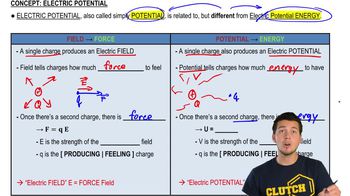
Electric Potential

Electric potential, measured in volts, is the amount of electric potential energy per unit charge at a point in space. It is a scalar quantity that represents the work done to move a unit positive charge from infinity to that point. The electric potential due to a point charge decreases with distance from the charge, and the total potential at a point is the algebraic sum of the potentials due to all charges present.
추천 영상:
가이드 코스
07:33
Electric Potential

Superposition Principle

The superposition principle states that the total electric potential at a point due to multiple charges is the sum of the potentials due to each charge considered independently. This principle allows us to analyze complex charge configurations by calculating the potential from each charge separately and then combining the results. It is essential for solving problems involving multiple charges, such as finding points where the total potential is zero.
추천 영상:
가이드 코스
03:32
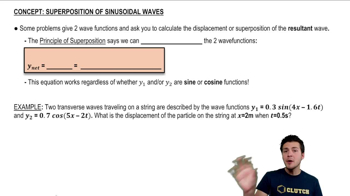
Superposition of Sinusoidal Wave Functions

Coordinate System and Symmetry

In this problem, the coordinate system is crucial for determining the positions of the charges and the points on the y-axis where the electric potential is zero. The symmetry of the charge distribution can simplify the analysis, as the electric potential will be influenced by the relative distances from the charges. Understanding how to set up the coordinate system and recognizing symmetrical properties can help identify potential points more efficiently.
추천 영상:
가이드 코스
12:39
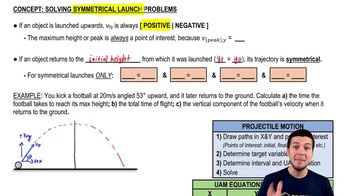
Solving Symmetric Launch Problems
관련 실천
교과서 질문

A −10.0 nC point charge and a +20.0 nC point charge are 15.0 cm apart on the x-axis. What is the electric potential at the point on the x-axis where the electric field is zero?

63
views

교과서 질문

A proton's speed as it passes point 1 is 50,000 m/s. It follows the trajectory shown in FIGURE P25.43. What is the proton's speed at point 2?

2240
views
교과서 질문

A +3.0 nC charge is at x=0 cm and a −1.0 nC charge is at x=4 cm. At what point or points on the x-axis is the electric potential zero?

88
views
교과서 질문

Two small metal cubes with masses 2.0 g and 4.0 g are tied together by a 5.0-cm-long massless string and are at rest on a frictionless surface. Each is charged to +2.0 μC. What is the tension in the string?

1911
views
교과서 질문

The four 1.0 g spheres shown in FIGURE P25.42 are released simultaneously and allowed to move away from each other. What is the speed of each sphere when they are very far apart?

2586
views
1
rank
교과서 질문

Living cells 'pump' singly ionized sodium ions, Na+, from the inside of the cell to the outside to maintain a membrane potential ΔVmembrane=Vin−Vout=−70 mV. It is called pumping because work must be done to move a positive ion from the negative inside of the cell to the positive outside, and it must go on continuously because sodium ions 'leak' back through the cell wall by diffusion. At rest, the human body uses energy at the rate of approximately 100 W to maintain basic metabolic functions. It has been estimated that 20% of this energy is used to operate the sodium pumps of the body. Estimate—to one significant figure—the number of sodium ions pumped per second.

1840
views
1
rank