Ch 25: The Electric Potential
Knight Calc - Physics for Scientists and Engineers 5th Edition
Knight Calc5th EditionPhysics for Scientists and EngineersISBN: 9780137344796당신이 사용하는 게 아니라요?교과서 변경
25장, 문제 15b

A proton with an initial speed of 800,000 m/s is brought to rest by an electric field. What was the potential difference that stopped the proton?

검증된 단계별 안내
1
Identify the relationship between the work done by the electric field and the change in the proton's kinetic energy. The work-energy principle states that the work done on the proton is equal to the change in its kinetic energy: \( W = \Delta KE \).
Express the work done by the electric field in terms of the potential difference \( \Delta V \). The work done on a charge \( q \) by an electric field is given by \( W = q \Delta V \), where \( q \) is the charge of the proton.
Calculate the initial kinetic energy of the proton using the formula \( KE = \frac{1}{2}mv^2 \), where \( m \) is the mass of the proton (\( 1.67 \times 10^{-27} \; \text{kg} \)) and \( v \) is its initial speed (\( 800,000 \; \text{m/s} \)).
Since the proton is brought to rest, its final kinetic energy is zero. The change in kinetic energy is therefore \( \Delta KE = KE_{\text{final}} - KE_{\text{initial}} = 0 - KE_{\text{initial}} = -KE_{\text{initial}} \).
Combine the equations \( W = q \Delta V \) and \( W = \Delta KE \) to find the potential difference: \( \Delta V = \frac{\Delta KE}{q} \). Substitute the values for \( \Delta KE \) (calculated in step 3) and \( q \) (the charge of a proton, \( 1.6 \times 10^{-19} \; \text{C} \)) to determine \( \Delta V \).

비슷한 문제에 대한 검증된 영상 답변:

이 영상 해법은 위 문제에 도움이 된다고 튜터들이 추천한 것입니다.

주요 개념

질문에 올바르게 답하기 위해 반드시 이해해야 하는 핵심 개념들은 다음과 같습니다.

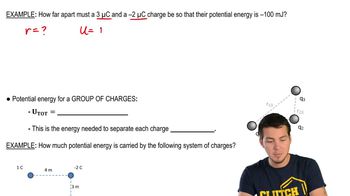
Electric Potential Energy

Electric potential energy is the energy a charged particle possesses due to its position in an electric field. When a charged particle, like a proton, moves within an electric field, it experiences a force that can change its kinetic energy. The work done by the electric field on the proton is equal to the change in its electric potential energy, which is crucial for understanding how the proton is brought to rest.
추천 영상:
가이드 코스
07:51
Electric Potential Energy

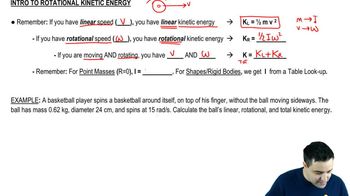
Kinetic Energy

Kinetic energy is the energy of an object due to its motion, calculated using the formula KE = 1/2 mv², where m is mass and v is velocity. In this scenario, the proton initially has a significant kinetic energy due to its high speed. As it moves through the electric field, this kinetic energy is converted into electric potential energy until the proton comes to a complete stop.
추천 영상:
가이드 코스
06:07
Intro to Rotational Kinetic Energy

Potential Difference (Voltage)

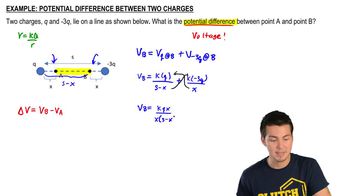
Potential difference, or voltage, is the work done per unit charge to move a charge between two points in an electric field. It is directly related to the electric field strength and the distance over which the field acts. In this case, the potential difference can be calculated using the relationship between the change in kinetic energy of the proton and the work done by the electric field, which ultimately stops the proton.
추천 영상:
가이드 코스
07:04
Potential Difference Between Two Charges