Two positive point charges are 5.0 cm apart. If the electric potential energy is 72 μJ, what is the magnitude of the force between the two charges?
Ch 25: The Electric Potential
25장, 문제 10a
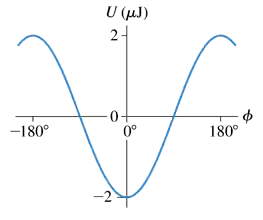
FIGURE EX25.10 shows the potential energy of an electric dipole. Consider a dipole that oscillates between ±60°. What is the dipole's mechanical energy?

검증된 단계별 안내1
Step 1: Understand the problem. The mechanical energy of the dipole is the sum of its potential energy and kinetic energy. Since the dipole oscillates between ±60°, its mechanical energy corresponds to the maximum potential energy at these angles.
Step 2: Analyze the graph. The graph shows the potential energy U (in μJ) as a function of the angle φ (in degrees). At ±60°, locate the corresponding potential energy value on the graph. This will be the maximum potential energy of the dipole during its oscillation.
Step 3: Recall that mechanical energy is conserved in oscillatory motion. The mechanical energy remains constant and is equal to the maximum potential energy when the dipole is at its turning points (±60°).
Step 4: Use the graph to determine the potential energy at ±60°. From the graph, visually identify the value of U at φ = ±60°. This value represents the mechanical energy of the dipole.
Step 5: Conclude that the mechanical energy of the dipole is equal to the potential energy at ±60°, as there is no kinetic energy at the turning points. Use the graph to confirm the numerical value of U at these angles.

비슷한 문제에 대한 검증된 영상 답변:
이 영상 해법은 위 문제에 도움이 된다고 튜터들이 추천한 것입니다.
주요 개념
질문에 올바르게 답하기 위해 반드시 이해해야 하는 핵심 개념들은 다음과 같습니다.
Electric Dipole
An electric dipole consists of two equal and opposite charges separated by a distance. It creates an electric field and experiences a torque when placed in an external electric field. The orientation of the dipole relative to the field affects its potential energy, which is minimized when aligned with the field.
추천 영상:
가이드 코스
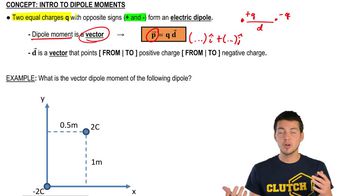
Intro To Dipole Moment
Potential Energy of a Dipole
The potential energy (U) of an electric dipole in an electric field is given by the equation U = -p·E·cos(θ), where p is the dipole moment, E is the electric field strength, and θ is the angle between the dipole moment and the field. This energy varies with the angle, reaching a maximum when the dipole is perpendicular to the field and a minimum when aligned with it.
추천 영상:
가이드 코스
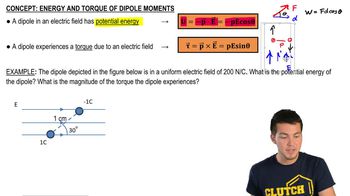
Energy & Torque of Dipole Moments
Mechanical Energy in Oscillations
Mechanical energy in oscillating systems, such as a dipole oscillating between ±60°, is the sum of kinetic and potential energy. As the dipole moves, its potential energy changes while kinetic energy varies inversely. The total mechanical energy remains constant if no external work is done, allowing the dipole to oscillate between its maximum and minimum potential energy states.
추천 영상:
가이드 코스
Conservation Of Mechanical Energy
관련 실천
교과서 질문
2165
views
교과서 질문
Three charged particles are placed at the corners of an equilateral triangle that has edge length 2.0 cm. One particle has charge +3.0 nC and a second has charge +6.0 nC. What is the third charge if the electric potential energy of the three charged particles is zero?
300
views
교과서 질문
What is the speed of an electron that has been accelerated from rest through a potential difference of 1000 V?
244
views
교과서 질문
What is the electric potential energy of the group of charges in FIGURE EX25.5?
526
views
교과서 질문
What potential difference is needed to accelerate an electron from rest to a speed of 2.0×10⁶ m/s?
275
views
교과서 질문
A proton with an initial speed of 800,000 m/s is brought to rest by an electric field. What was the potential difference that stopped the proton?
166
views