Ch 25: The Electric Potential
Knight Calc - Physics for Scientists and Engineers 5th Edition
Knight Calc5th EditionPhysics for Scientists and EngineersISBN: 9780137344796당신이 사용하는 게 아니라요?교과서 변경
25장, 문제 82b

A thin rod of length L and total charge Q has the nonuniform linear charge distribution λ(x)=λ₀x/L, where x is measured from the rod's left end. What is the electric potential on the axis at distance d left of the rod's left end?

검증된 단계별 안내
1
Understand the problem: The electric potential at a point due to a charge distribution is calculated by integrating the contributions from each infinitesimal charge element. Here, the charge distribution is nonuniform, given by λ(x) = λ₀x/L, and we need to find the potential at a point located at a distance d to the left of the rod's left end.
Express the infinitesimal charge element: The linear charge density λ(x) is the charge per unit length. For a small segment of the rod of length dx at position x, the infinitesimal charge is dQ = λ(x)dx. Substituting λ(x), we get dQ = (λ₀x/L)dx.
Write the expression for the electric potential: The electric potential dV at a point due to an infinitesimal charge dQ is given by dV = (1 / (4πε₀)) * (dQ / r), where r is the distance from the charge element to the point of interest. Here, r = d + x, so dV = (1 / (4πε₀)) * ((λ₀x/L)dx / (d + x)).
Set up the integral: To find the total electric potential V, integrate dV over the length of the rod. The limits of integration are from x = 0 (left end of the rod) to x = L (right end of the rod). Thus, V = ∫[0 to L] (1 / (4πε₀)) * ((λ₀x/L) / (d + x)) dx.
Simplify and solve the integral: Factor out constants (1 / (4πε₀)) * (λ₀ / L) from the integral. The remaining integral is ∫[0 to L] (x / (d + x)) dx. Use substitution or partial fraction techniques to evaluate this integral. Once the integral is solved, substitute the limits to find the expression for the electric potential V.

비슷한 문제에 대한 검증된 영상 답변:

이 영상 해법은 위 문제에 도움이 된다고 튜터들이 추천한 것입니다.
영상 길이:
8m
도움이 되었나요?

주요 개념

질문에 올바르게 답하기 위해 반드시 이해해야 하는 핵심 개념들은 다음과 같습니다.

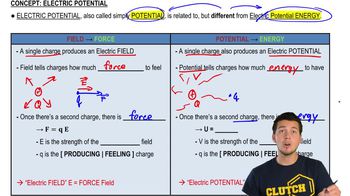
Electric Potential

Electric potential is the amount of electric potential energy per unit charge at a point in an electric field. It is a scalar quantity measured in volts (V) and indicates the work done to move a unit positive charge from a reference point to a specific point in the field without any acceleration.
추천 영상:
가이드 코스
07:33
Electric Potential

Linear Charge Density

Linear charge density (λ) is defined as the amount of electric charge per unit length along a line, typically expressed in coulombs per meter (C/m). In this case, the charge distribution is nonuniform, meaning it varies along the length of the rod, which affects the calculation of the electric potential at different points.
추천 영상:
가이드 코스
8:13
Intro to Density

Integration in Electric Field Calculations

In problems involving continuous charge distributions, integration is used to calculate quantities like electric potential. This involves summing contributions from infinitesimal charge elements along the distribution, taking into account their distances from the point of interest, which allows for the determination of the total potential at a specific location.
추천 영상:
가이드 코스
11:43
Finding Moment Of Inertia By Integrating