
Ch 25: The Electric Potential
Knight Calc - Physics for Scientists and Engineers 5th Edition
Knight Calc5th EditionPhysics for Scientists and EngineersISBN: 9780137344796당신이 사용하는 게 아니라요?교과서 변경
25장, 문제 81

Two 2.0-mm-diameter beads, C and D, are 10 mm apart, measured between their centers. Bead C has mass 1.0 g and charge 2.0 nC. Bead D has mass 2.0 g and charge −1.0 nC. If the beads are released from rest, what are the speeds vC and vD at the instant the beads collide?

검증된 단계별 안내
1
Step 1: Identify the forces acting on the beads. The beads are charged, so they experience an electrostatic force due to Coulomb's law. The formula for the electrostatic force is: F=kqq'r2, where k is Coulomb's constant, q and q' are the charges, and r is the distance between the beads.
Step 2: Recognize that the beads will accelerate toward each other due to the electrostatic force. Use the work-energy principle to relate the initial potential energy of the system to the kinetic energy of the beads at the moment they collide. The potential energy is given by: U=kqq'r, where r is the initial separation distance.
Step 3: Apply conservation of energy. The total mechanical energy of the system is conserved, so the initial potential energy is converted into the kinetic energy of the beads. The kinetic energy of each bead is given by: K=12mv2, where m is the mass and v is the speed of the bead.
Step 4: Use the principle of conservation of momentum to relate the velocities of the beads. Since the beads start from rest and no external forces act on the system, the total momentum of the system is conserved. The equation for conservation of momentum is: mCvC=mDvD, where mC and mD are the masses of beads C and D, and vC and vD are their respective velocities.
Step 5: Solve the system of equations formed by conservation of energy and conservation of momentum to find the speeds vC and vD. Substitute the given values for the charges, masses, and initial separation distance into the equations to calculate the final speeds.

비슷한 문제에 대한 검증된 영상 답변:

이 영상 해법은 위 문제에 도움이 된다고 튜터들이 추천한 것입니다.
영상 길이:
16m
도움이 되었나요?

주요 개념

질문에 올바르게 답하기 위해 반드시 이해해야 하는 핵심 개념들은 다음과 같습니다.

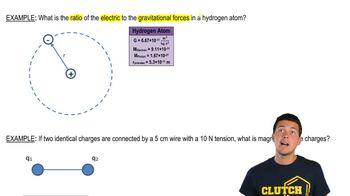
Coulomb's Law

Coulomb's Law describes the electrostatic force between two charged objects. It states that the force is directly proportional to the product of the magnitudes of the charges and inversely proportional to the square of the distance between their centers. This principle is crucial for understanding the interaction between beads C and D, as their charges will create a force that influences their motion.
추천 영상:

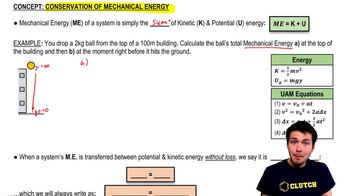
Conservation of Energy

The principle of conservation of energy states that the total energy in a closed system remains constant. In this scenario, the potential energy due to the electrostatic force between the beads will convert into kinetic energy as they move towards each other. This concept allows us to relate the initial potential energy to the final kinetic energies of the beads at the moment of collision.
추천 영상:
가이드 코스
06:24
Conservation Of Mechanical Energy

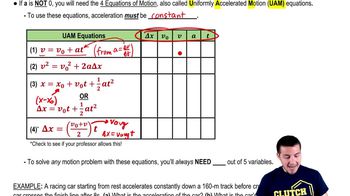
Kinematics

Kinematics is the branch of mechanics that deals with the motion of objects without considering the forces that cause the motion. In this problem, kinematic equations can be used to relate the speeds of the beads at the moment of collision to their initial conditions and the distances they travel. Understanding kinematics is essential for calculating the final speeds of beads C and D.
추천 영상:
가이드 코스
08:25
Kinematics Equations