Ch 25: The Electric Potential
Knight Calc - Physics for Scientists and Engineers 5th Edition
Knight Calc5th EditionPhysics for Scientists and EngineersISBN: 9780137344796당신이 사용하는 게 아니라요?교과서 변경
25장, 문제 36c

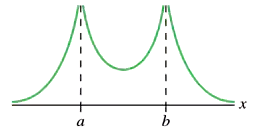
Two point charges qₐ and qᵦ are located on the x-axis at x=a and x=b. FIGURE EX25.36 is a graph of V, the electric potential. Draw a graph of Eₓ, the x-component of the electric field, as a function of x.
Graph showing the electric potential V as a function of x, with marked points a and b on the x-axis.

검증된 단계별 안내
1
Understand the relationship between electric potential (V) and electric field (E). The electric field is the negative gradient of the electric potential: Eₓ = -dV/dx. This means the slope of the V(x) graph determines the value of Eₓ.
Analyze the graph of V(x) provided in FIGURE EX25.36. Identify regions where the slope is positive, negative, or zero. A positive slope corresponds to a negative Eₓ, a negative slope corresponds to a positive Eₓ, and a zero slope corresponds to Eₓ = 0.
Determine the locations of the charges qₐ and qᵦ on the x-axis (at x = a and x = b). Near these points, the electric potential will exhibit steep changes, indicating strong electric fields. The direction of the field depends on the sign of the charges.
Sketch the graph of Eₓ as a function of x. For each region of the x-axis, use the slope of the V(x) graph to determine the magnitude and direction of Eₓ. Ensure that the graph reflects discontinuities or sharp changes near the charges, as the electric field is strongest near the charges.
Label the graph appropriately, marking key points such as x = a and x = b, and ensure the behavior of Eₓ aligns with the physical principles of electric fields and potentials. For example, Eₓ should point away from positive charges and toward negative charges.

비슷한 문제에 대한 검증된 영상 답변:

이 영상 해법은 위 문제에 도움이 된다고 튜터들이 추천한 것입니다.
영상 길이:
6m

주요 개념

질문에 올바르게 답하기 위해 반드시 이해해야 하는 핵심 개념들은 다음과 같습니다.

Electric Potential (V)

Electric potential, denoted as V, is the amount of electric potential energy per unit charge at a point in an electric field. It is a scalar quantity that indicates how much work would be done to move a charge from a reference point to a specific point in the field without any acceleration. The potential due to point charges can be calculated using the formula V = k * (q/r), where k is Coulomb's constant, q is the charge, and r is the distance from the charge.
추천 영상:
가이드 코스
07:33
Electric Potential

Electric Field (E)

The electric field, represented as E, is a vector field that describes the force exerted per unit charge at any point in space due to electric charges. It is defined as the negative gradient of the electric potential, meaning that E = -dV/dx in one dimension. The direction of the electric field is away from positive charges and towards negative charges, indicating the direction a positive test charge would move in the field.
추천 영상:
가이드 코스
03:16
Intro to Electric Fields

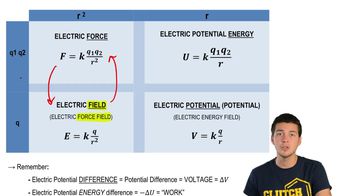
Relationship Between Electric Potential and Electric Field

The relationship between electric potential and electric field is fundamental in electrostatics. The electric field is derived from the electric potential by taking the spatial derivative, which shows how the potential changes with position. This relationship allows us to graph the electric field as a function of position by analyzing the slope of the potential graph; where the potential decreases rapidly, the electric field is strong, and where it is flat, the electric field is weak.
추천 영상:
가이드 코스
03:43
Relationships Between Force, Field, Energy, Potential